AI Video Editing - Lighting - High Contrast
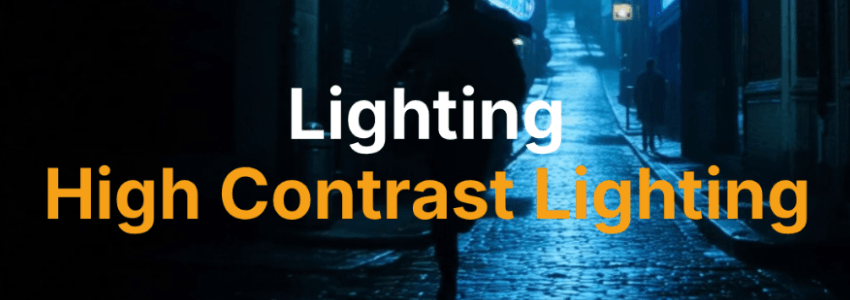
High contrast lighting is one of the most dramatic lighting techniques available in AI video generation, carving bold shapes out of deep shadow and bright highlight to create images that pulse with tension and visual intensity. This technique pushes the extremes of light and dark, making it a favorite for noir, thriller, and horror scenes where every shadow hides a threat and every sliver of light feels hard-won. By combining strong intensity with precise angle and tone choices from the lighting stack, you gain full control over how the AI renders drama on screen. This page explains what the technique is, when to use it, and how it compares to softer alternatives, along with a ready-to-use example prompt.
What is "High Contrast Lighting"?
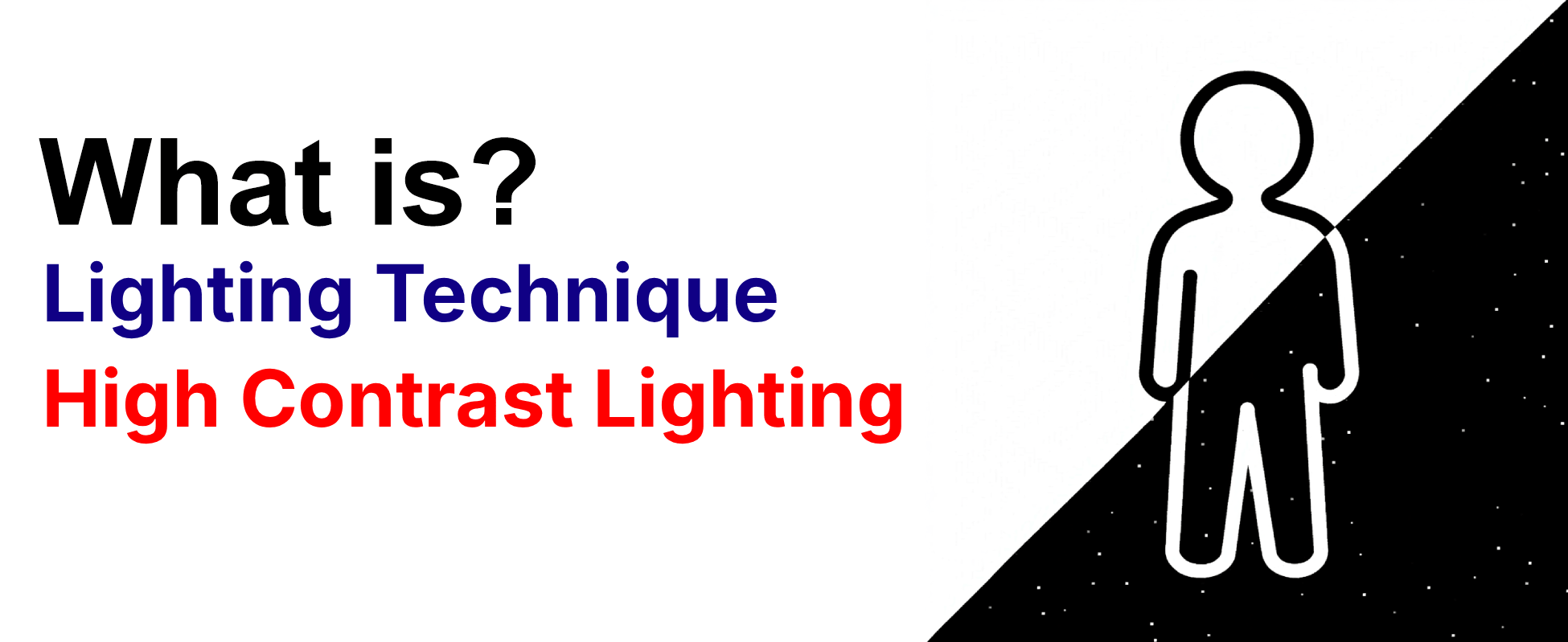
High contrast lighting is a dramatic style that emphasizes extreme differences between the brightest highlights and the deepest shadows, often using a single strong light source to carve out sharp, defined shapes. This technique creates a bold, graphic look that heightens tension, mystery, and visual intensity by leaving large areas of the frame in near darkness. Filmmakers employ high contrast lighting in noir, thriller, and horror genres to convey danger, moral ambiguity, or a heightened sense of psychological pressure. Unlike soft or low-contrast lighting, which wraps the subject in gentle gradients, high contrast lighting draws hard lines between what is revealed and what is concealed, forcing the viewer's eye to the lit areas while the shadows become an active storytelling element.
In the lighting stack introduced in Chapter 7, high contrast lighting sits at the intensity/type position. The keyword "high contrast lighting" tells the AI to maximize the difference between light and dark areas, producing deep blacks and bright whites. When combined with a hard light source such as a Fresnel or spotlight, and a precise angle like 45° side lighting or top-down lighting, the effect becomes even more striking. The classic cinematic term for this interplay of light and shadow is chiaroscuro, a technique that has been used in painting and film for centuries to create mood and drama.
To construct a high contrast lighting prompt, follow the stack order from the book: time of day, light source, angle, tone, intensity/type. For example: "Night time, artificial street light at 45° side angle, cold steel-blue tone, high contrast hard light." This order helps the AI process each lighting parameter in a logical hierarchy, resulting in more predictable and cinematic output. You can further enhance the effect by adding modifiers such as "colored gels" for stylized color contrast, "edge lighting" to separate the subject from the background, or "god-rays" if atmospheric particles like fog or dust are present to make the light beams visible.
Example Prompt
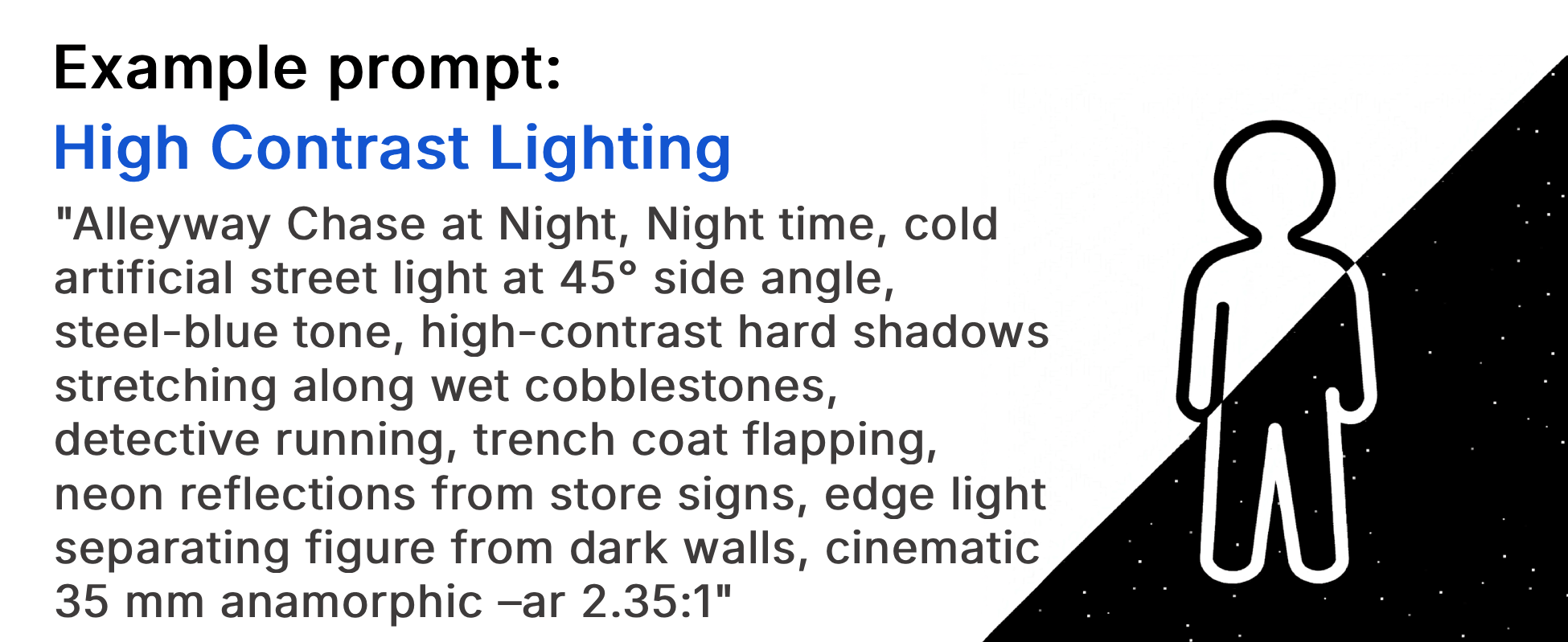
"Alleyway Chase at Night, Night time, cold artificial street light at 45° side angle, steel-blue tone, high-contrast hard shadows stretching along wet cobblestones, detective running, trench coat flapping, neon reflections from store signs, edge light separating figure from dark walls, cinematic 35 mm anamorphic –ar 2.35:1"
Example Video
When to use High Contrast Lighting?
High contrast lighting works best when a scene calls for tension, danger, or moral ambiguity, such as noir detective sequences, thriller confrontations, or horror reveals where shadows conceal as much as light reveals. It is also effective for creating a bold, graphic visual style in music videos or stylized action sequences where visual impact matters more than realism. When combined with cool tones like steel-blue or desaturated colors, it amplifies feelings of isolation and unease. When paired with warm tones, it can suggest a dangerous allure or oppressive heat. Avoid this technique for warm, intimate, or lighthearted scenes, where softer lighting will better preserve comfort and emotional closeness.
- Scene needs tension, danger, or mystery
- Noir, thriller, or horror genre
- Shadows should conceal as much as light reveals
- A bold, graphic visual style fits the mood
- Moral ambiguity or psychological pressure is central to the story
- Cool or desaturated tones can amplify isolation and unease
- Edge lighting is needed to separate the subject from dark backgrounds
Pros and Cons of High Contrast Lighting
| Pros | Cons |
|---|---|
| Creates dramatic, eye-catching visuals with bold shapes and deep shadows | Can obscure important details if shadows are too dominant |
| Heightens tension, mystery, and emotional intensity effectively | Difficult to maintain consistent exposure across multiple clips |
| Forces the viewer's attention to exactly where the light falls, guiding the eye | Unsuitable for warm, intimate, or lighthearted scenes where softness is preferred |
| Pairs naturally with edge lighting and colored gels for stylized, cinematic results | May cause blown-out highlights if the key light is too strong without fill |
| Makes shadows an active storytelling element rather than empty space | Requires careful iteration; the AI may over-light or flatten contrast on first attempts |
Recommended book

Learn more about AI video editing
Learn more about AI video editing by reading the book How to Make AI Videos by Gyula Rabai. In this book you can find very important information about: Camera Movement, Lighting, Colors, Composition, Consistency, Character emotion, Character motion, Video style, Action Control and Sound design This information will make your videos more professional, and more engaging.
Get your copy here:
https://videcool.com/p_3707-how-to-make-ai-videos-by-gyula-rabai-book.html
Conclusion
High contrast lighting is a powerful tool for filmmakers and prompt engineers who want to inject drama, tension, and visual intensity into a scene. By deliberately pushing the extremes of light and shadow, it transforms ordinary frames into bold, graphic compositions where darkness becomes an active storytelling element. When constructed using the lighting stack, specifying time of day, light source, angle, tone, and intensity in order, high contrast prompts become predictable and repeatable, giving you cinematic control over every frame. It is not the right choice for every scene, but when noir atmosphere, thriller suspense, or horror dread are the goal, few techniques communicate them as effectively. Used thoughtfully alongside softer lighting approaches and refined through iteration, it becomes a versatile addition to any AI video generation toolkit.