AI Video Editing - Composition - Leading Lines
Leading lines are one of the most powerful compositional tools available in AI video generation, drawing the viewer's eye along visual paths toward the subject or focal point of a scene. Whether through straight roads, curved pathways, or diagonal shadows, these directional elements add depth, movement, and narrative flow to every frame. This page explains what the technique is, when to use it, and how it compares to other compositional approaches, along with a ready-to-use example prompt.

What is the "Leading Lines" technique?
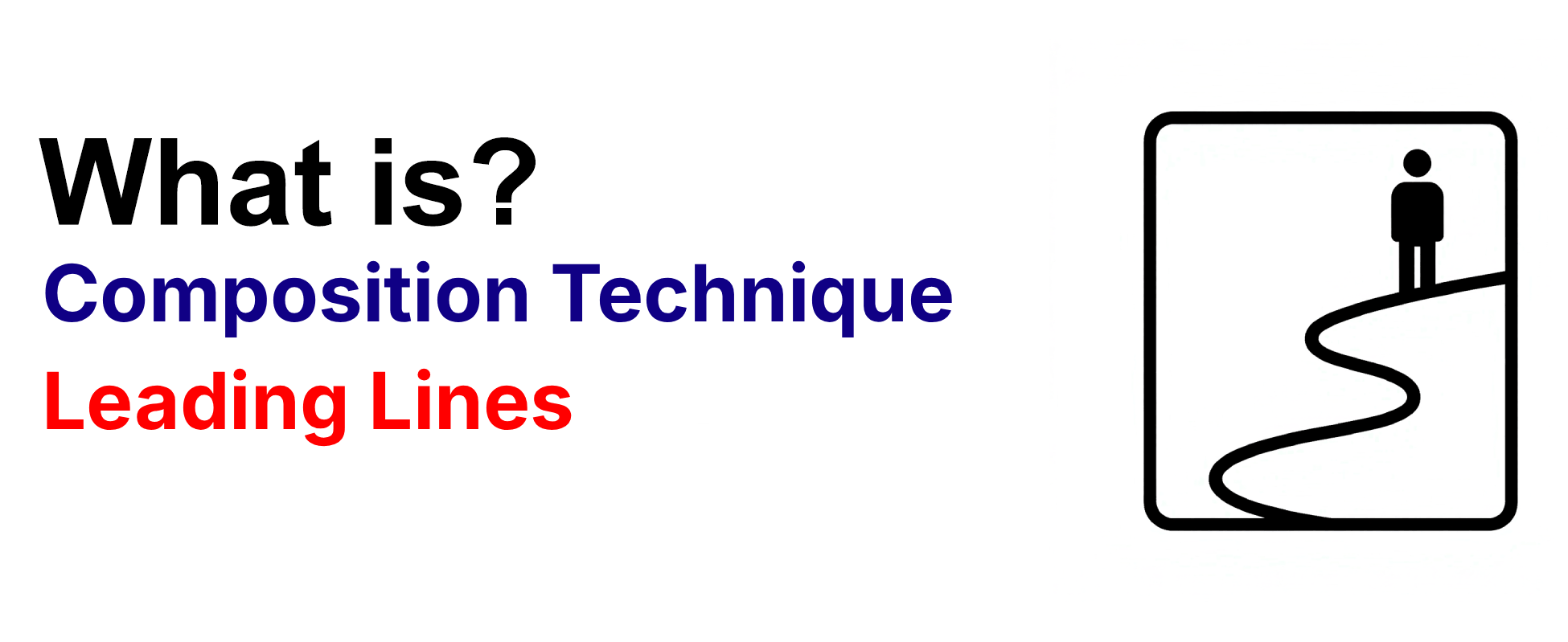
Leading lines are visual paths within the frame, such as roads, edges, shadows, rails, or patterns, that guide the viewer's eye toward the subject or focal point of the composition. These directional elements add depth, movement, and narrative flow, creating a sense of journey or discovery as the eye travels along the line to its destination. Directors use leading lines to control attention, build tension, and create a sense of depth that pulls the audience into the scene, whether through straight paths for urgency or curved lines for mystery. In AI prompts, you can specify the line type and convergence to control focus and narrative flow. For example, in 2001: A Space Odyssey (1968), director Stanley Kubrick used symmetrical lines in the monolith scenes that lead to infinity, creating awe. In Nightcrawler (2014), director Dan Gilroy uses diagonal lines from feet to a crash site, pulling viewers into chaos.
Example Prompt
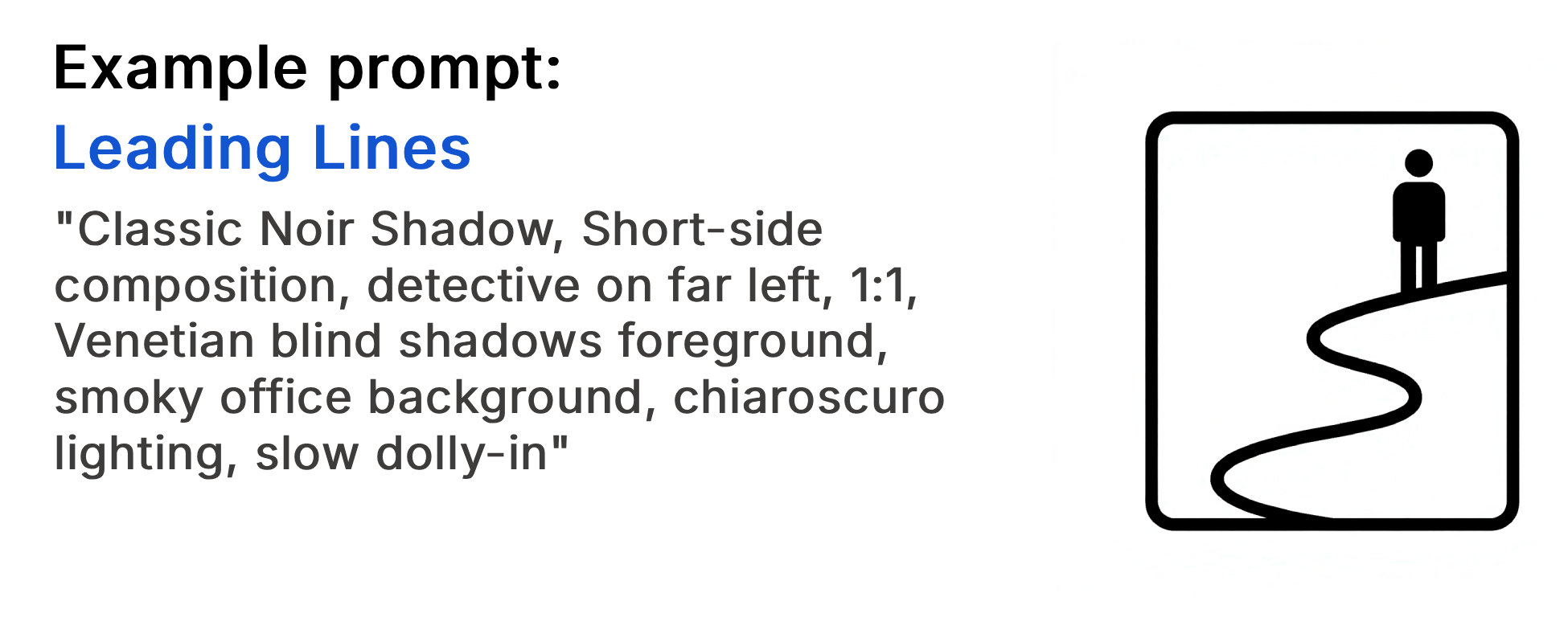
"Classic Noir Shadow, Short-side composition, detective on far left, 1:1, Venetian blind shadows foreground, smoky office background, chiaroscuro lighting, slow dolly-in"
Example Video
When to use the Leading Lines technique?
The leading lines technique works best when a scene calls for visual direction, depth, or a sense of journey, such as guiding the viewer's eye toward a key subject, building tension through converging paths, or creating a feeling of discovery as the eye travels along the line. It is also effective for establishing scale and perspective, as lines that recede into the distance naturally communicate spatial depth. Straight lines are ideal for urgency and direct focus, curved lines evoke mystery or a calm journey, and diagonal lines add energy and tension. Avoid this technique when the scene requires a flat, minimalist composition where directional elements would distract from the subject, or when too many competing lines create visual confusion rather than clarity.
- The scene needs visual direction toward a focal point
- You want to create a sense of depth or perspective
- A journey or pathway is central to the narrative
- Tension should build through converging lines
- The environment naturally contains roads, corridors, or edges
Pros and Cons of Leading Lines
| Pros | Cons |
|---|---|
| Guides the viewer's eye directly to the subject, ensuring clear focal hierarchy | Can feel overly contrived or forced if lines are too obvious or artificial |
| Adds depth and dimensionality to flat or simple compositions | Competing lines can create visual confusion and dilute the intended focus |
| Enhances narrative flow by creating a visual journey through the frame | May not suit minimalist or intentionally flat compositions |
Recommended book

Learn more about AI video editing
Learn more about AI video editing by reading the book How to Make AI Videos by Gyula Rabai. In this book you can find very important information about: Camera Movement, Lighting, Colors, Composition, Consistency, Character emotion, Character motion, Video style, Action Control and Sound design This information will make your videos more professional, and more engaging.
Conclusion
Leading lines are a versatile and powerful tool for filmmakers and prompt engineers who want to guide the viewer's eye and add depth to a scene. By strategically placing directional elements within the frame, you can control attention, build tension, and create a sense of journey that pulls the audience into the composition. Whether using straight lines for urgency, curved paths for mystery, or converging lines for intensity, this technique transforms a flat image into a dynamic visual experience. It is not the right choice for every scene, but when direction, depth, or narrative flow are the goal, few compositional techniques communicate them as effectively. Used thoughtfully alongside other compositional tools, leading lines become a valuable addition to any AI video generation toolkit.