
AI Video Editing - Consistency - Global Palette
A global palette is one of the most effective consistency techniques available in AI video generation, locking a fixed set of colors across every shot to maintain visual unity and emotional tone throughout a project. This technique prevents the AI from drifting into different color schemes between scenes, ensuring each frame feels like part of the same cohesive world. This page explains what the technique is, when to use it, and how it compares to other consistency approaches, along with a ready-to-use example prompt.
What is a Global Palette?
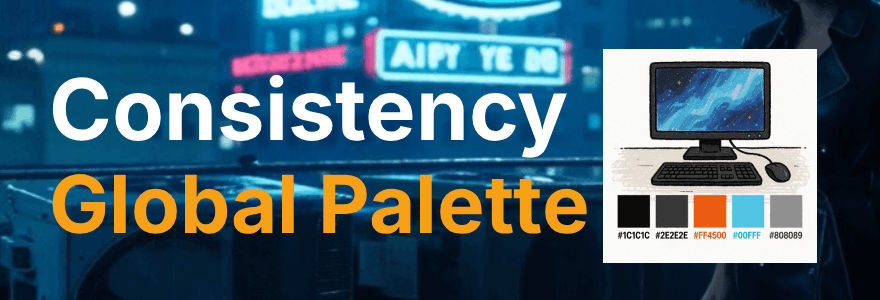
A global palette is a consistency technique that locks a fixed set of 3 to 5 specific colors, often defined by HEX codes or named hues, across every shot in a video project to maintain visual unity. This prevents the AI from drifting into different color schemes between scenes, ensuring the emotional tone and professional polish remain consistent throughout the narrative. Directors use the global palette keyword to anchor the entire film's color identity, making each scene feel like part of a cohesive visual world rather than disconnected fragments. When combined with the no_palette_shift directive, the AI is further constrained from altering the color grade, keeping shadows, highlights, and midtones locked from the first frame to the last.
Example Prompt
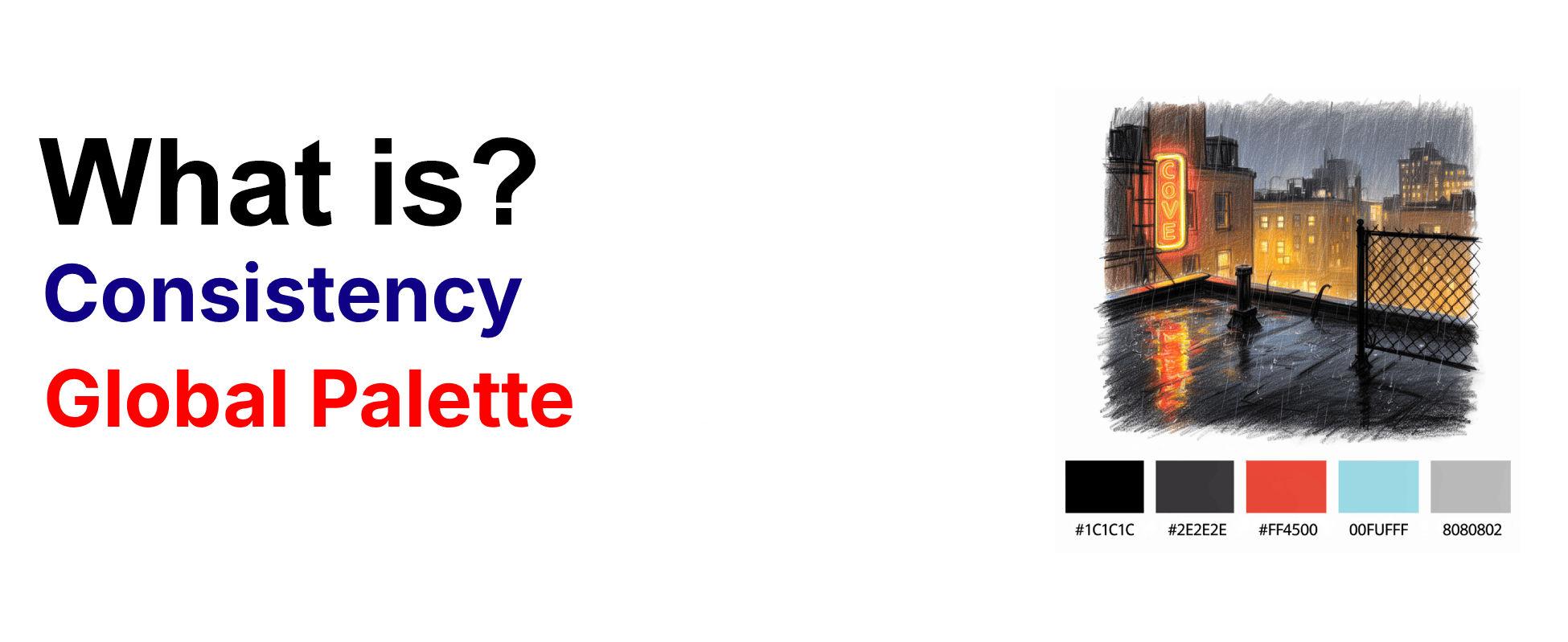
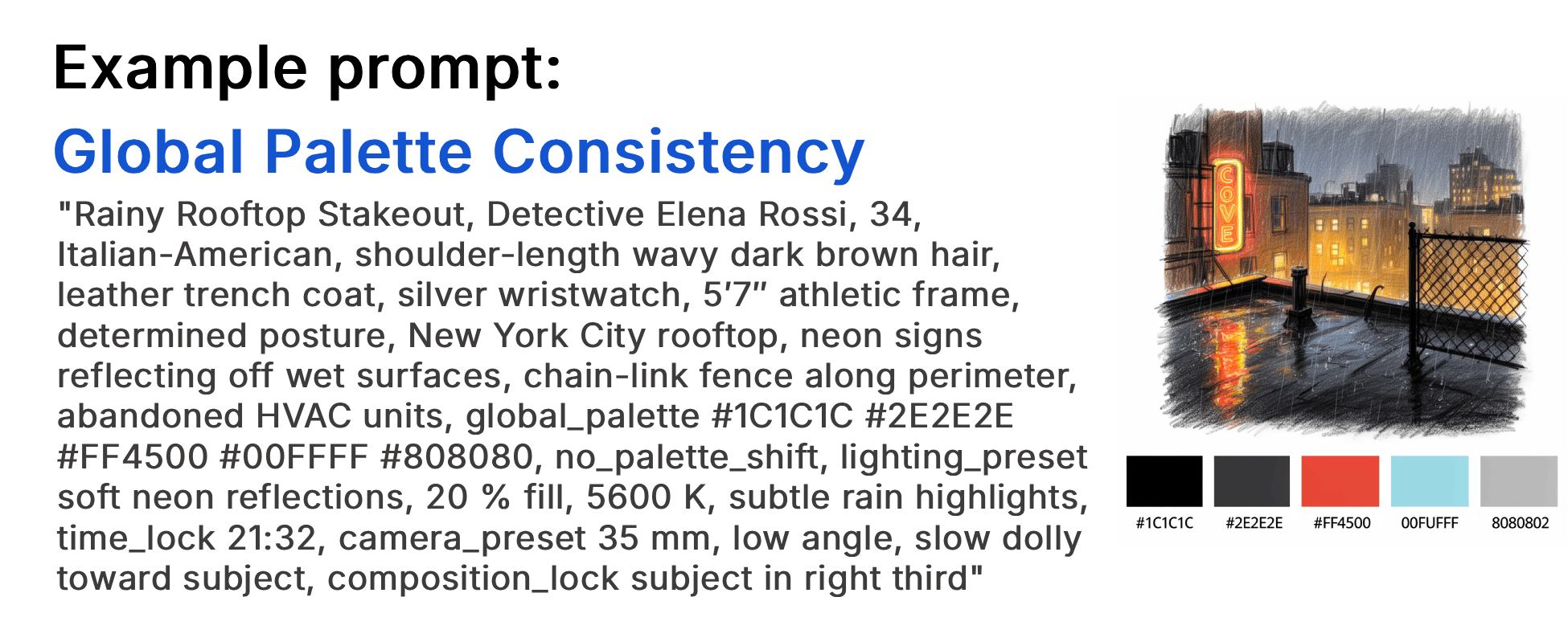
"Rainy Rooftop Stakeout, Detective Elena Rossi, 34, Italian-American, shoulder-length wavy dark brown hair, leather trench coat, silver wristwatch, 5′7″ athletic frame, determined posture, New York City rooftop, neon signs reflecting off wet surfaces, chain-link fence along perimeter, abandoned HVAC units, global_palette #1C1C1C #2E2E2E #FF4500 #00FFFF #808080, no_palette_shift, lighting_preset soft neon reflections, 20 % fill, 5600 K, subtle rain highlights, time_lock 21:32, camera_preset 35 mm, low angle, slow dolly toward subject, composition_lock subject in right third"
Prompt Breakdown
| Category | Prompt Text |
|---|---|
| Character consistency | "Detective Elena Rossi, 34, Italian-American, shoulder-length wavy dark brown hair, leather trench coat, silver wristwatch, 5′7″ athletic frame, determined posture" |
| Scene consistency | "New York City rooftop, neon signs reflecting off wet surfaces, chain-link fence along perimeter, abandoned HVAC units" |
| Palette consistency | "global_palette #1C1C1C #2E2E2E #FF4500 #00FFFF #808080, no_palette_shift" |
| Lighting consistency | "lighting_preset soft neon reflections, 20 % fill, 5600 K, subtle rain highlights, time_lock 21:32" |
| Camera consistency | "camera_preset 35 mm, low angle, slow dolly toward subject, composition_lock subject in right third" |
Example Video
When to use the Global Palette technique?
The global palette technique works best when a project spans multiple scenes that must feel like part of the same visual world, such as a short film, a music video, or a multi-shot narrative where color continuity is essential. It is also highly effective when a specific mood or brand identity needs to be maintained throughout, since locked HEX codes ensure the same emotional undertone in every frame. Use this technique when you want to prevent the AI from introducing unwanted color shifts between renders, particularly in projects with complex lighting setups where the AI might reinterpret the color grade. Avoid this technique for experimental or dreamlike sequences where deliberate color variation serves the storytelling, or in single-shot videos where palette drift is not a concern.
- The project spans multiple scenes requiring color continuity
- A specific mood or brand identity must be maintained throughout
- The AI tends to drift between color schemes between renders
- Complex lighting setups risk unintended color reinterpretation
- A cohesive visual world is more important than color variety
Pros and Cons of the Global Palette
| Pros | Cons |
|---|---|
| Locks visual identity across all scenes, preventing color drift | Can feel visually monotonous if the palette is too restrictive |
| Maintains consistent emotional tone and professional polish | Requires advance planning to choose the right palette before generating |
| Works seamlessly with other consistency techniques like lighting and camera presets | Difficult to adjust mid-project without re-rendering earlier scenes |
Recommended book

Learn more about AI video editing
Learn more about AI video editing by reading the book How to Make AI Videos by Gyula Rabai. In this book you can find very important information about: Camera Movement, Lighting, Colors, Composition, Consistency, Character emotion, Character motion, Video style, Action Control and Sound design This information will make your videos more professional, and more engaging.
Get your copy here:
https://videcool.com/p_3707-how-to-make-ai-videos-by-gyula-rabai-book.html
Conclusion
The global palette is a powerful tool for filmmakers and prompt engineers who want to maintain visual unity and emotional consistency across multiple scenes in AI video generation. By locking a fixed set of colors with HEX codes and the no_palette_shift directive, it prevents the AI from drifting into different color schemes, ensuring every frame feels like part of the same cohesive world. It is not the right choice for every project, particularly those that benefit from deliberate color variation, but when continuity and professional polish are the goal, few techniques are as effective. Used thoughtfully alongside character, scene, lighting, and camera consistency techniques, the global palette becomes an essential addition to any AI video generation toolkit.