
AI Video Editing - Consistency - Composition Lock
A composition lock is a framing consistency keyword that fixes the rule-of-thirds placement or symmetry of the subject across every shot, ensuring the same visual weighting is maintained throughout an AI generated video sequence. Without it, the camera can randomly reposition the subject between takes, breaking the intended emotional impact of the composition. This page explains what a composition lock is, when to use it, and how it compares to free-form framing, along with a ready-to-use example prompt.

What is a "Composition Lock" consistency technique?
A composition lock is a framing consistency keyword that fixes the rule-of-thirds placement or symmetry of the subject, ensuring the same visual weighting is maintained across every shot. This technique prevents the camera from randomly repositioning the subject between takes, preserving the intended emotional impact of the composition. Directors use composition locks to anchor the visual storytelling, so that a character remains consistently on the left third for introspection or center-weighted for confrontation throughout the entire sequence. In AI video generation, composition locks are especially important because the AI model has no inherent memory of where it placed the subject in the previous frame, making deliberate positioning instructions essential for visual continuity.
Example Prompt
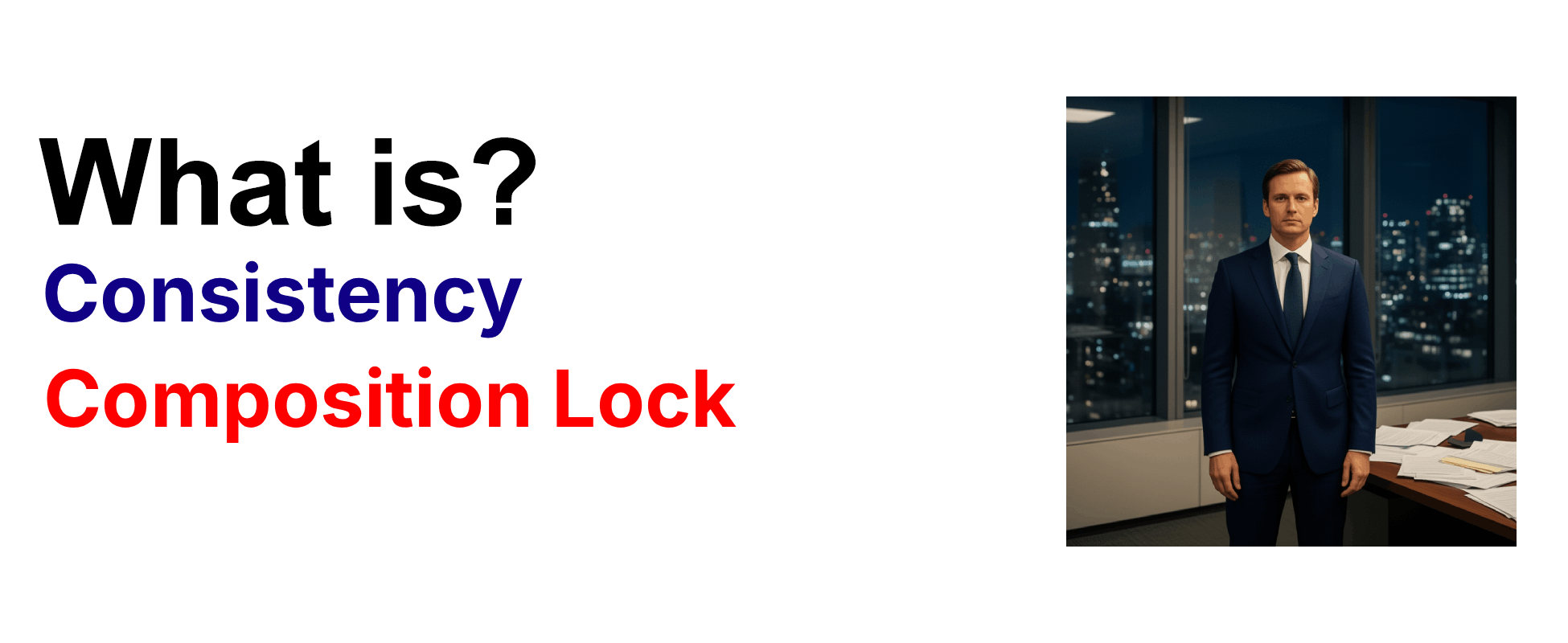
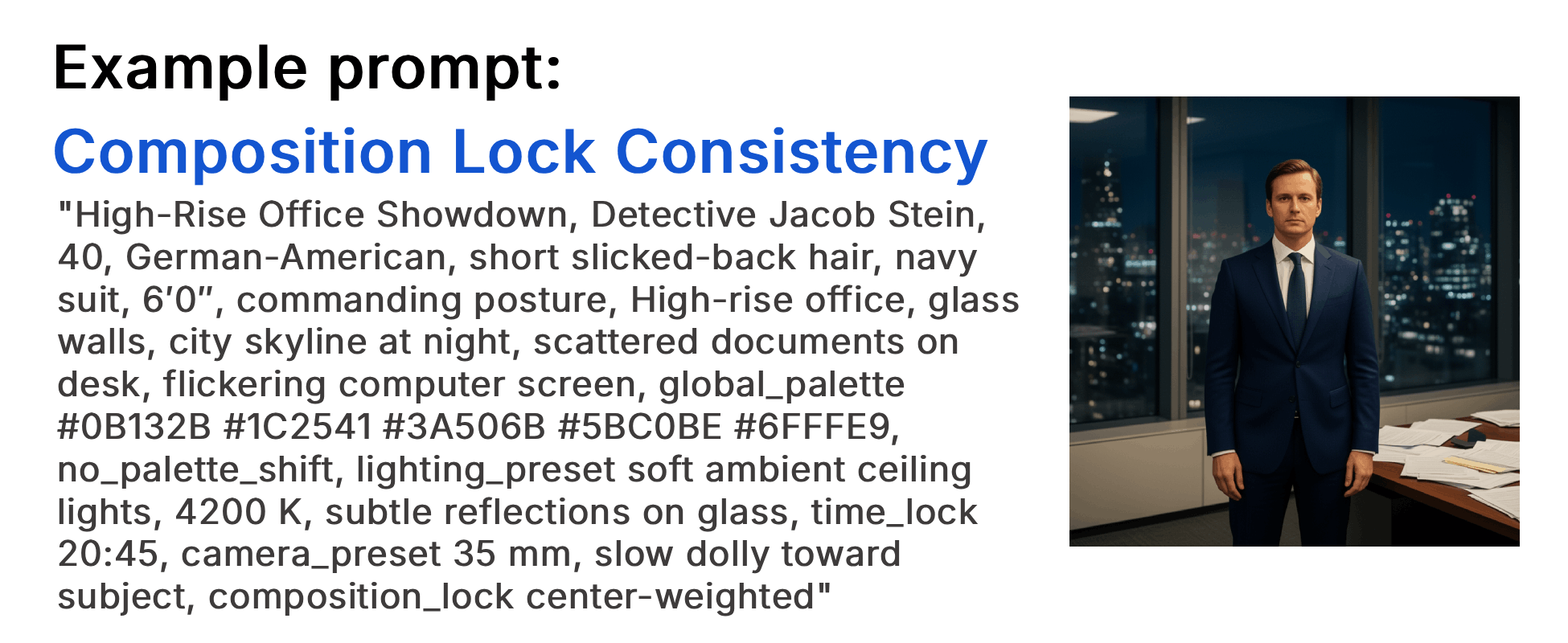
"High-Rise Office Showdown, Detective Jacob Stein, 40, German-American, short slicked-back hair, navy suit, 6′0″, commanding posture, High-rise office, glass walls, city skyline at night, scattered documents on desk, flickering computer screen, global_palette #0B132B #1C2541 #3A506B #5BC0BE #6FFFE9, no_palette_shift, lighting_preset soft ambient ceiling lights, 4200 K, subtle reflections on glass, time_lock 20:45, camera_preset 35 mm, slow dolly toward subject, composition_lock center-weighted"
Prompt Breakdown
| Category | Prompt Text |
|---|---|
| Character consistency | "Detective Jacob Stein, 40, German-American, short slicked-back hair, navy suit, 6′0″, commanding posture" |
| Scene consistency | "High-rise office, glass walls, city skyline at night, scattered documents on desk, flickering computer screen" |
| Palette consistency | "global_palette #0B132B #1C2541 #3A506B #5BC0BE #6FFFE9, no_palette_shift" |
| Lighting consistency | "lighting_preset soft ambient ceiling lights, 4200 K, subtle reflections on glass, time_lock 20:45" |
| Camera consistency | "camera_preset 35 mm, slow dolly toward subject, composition_lock center-weighted" |
Example Video
When to use a Composition Lock?
A composition lock works best when visual continuity across shots is critical to storytelling, such as dialogue sequences where characters must maintain consistent screen positioning, or action scenes where spatial relationships between subjects need to remain stable. It is also valuable when using a specific compositional style, such as left-weighted framing for introspective moments or center-weighted framing for confrontations, that must carry through an entire sequence. Avoid using a composition lock when deliberate compositional variety is part of the creative intent, such as montage sequences or scenes designed to feel chaotic and disorienting.
- A character must stay in the same screen position across cuts
- The scene relies on a specific compositional style (left-weighted, center-weighted, symmetrical)
- Spatial relationships between subjects need to remain stable
- Visual continuity is critical for dialogue or confrontation sequences
- The AI model keeps shifting subject placement between prompts
Pros and Cons of the Composition Lock
| Pros | Cons |
|---|---|
| Maintains consistent subject placement across all shots in a sequence | Can feel visually repetitive if overused across an entire project |
| Preserves the emotional intent of the composition (e.g., isolation, confrontation) | Restricts creative freedom to vary framing for dramatic effect within a scene |
| Prevents AI from randomly repositioning subjects between frames | Requires careful planning of compositional choices before prompting |
Recommended book
Learn more about AI video editing
Learn more about AI video editing by reading the book How to Make AI Videos by Gyula Rabai. In this book you can find very important information about: Camera Movement, Lighting, Colors, Composition, Consistency, Character emotion, Character motion, Video style, Action Control and Sound design This information will make your videos more professional, and more engaging.
Get your copy here:
https://videcool.com/p_3707-how-to-make-ai-videos-by-gyula-rabai-book.html
Conclusion
A composition lock is an essential tool for filmmakers and prompt engineers who need consistent visual framing across AI generated video sequences. By fixing the rule-of-thirds placement or symmetry of the subject, it prevents the AI from drifting between compositions and preserves the emotional weight of each shot. It is not the right choice for every scene, but when continuity of subject placement and compositional intent matter, few techniques are as effective. Used thoughtfully alongside other consistency keywords like camera_preset and lighting_preset, the composition lock becomes a powerful addition to any AI video generation toolkit.