
AI Video Editing - Consistency - Time Lock
A time lock is a lighting consistency keyword that freezes the sun, moon, or artificial light source at a specific time of day, preventing the AI from arbitrarily shifting the illumination between shots. This technique ensures that shadows, color temperature, and atmospheric mood remain consistent from the first frame to the last. This page explains what a time lock is, when to use it, and how it compares to other consistency techniques, along with a ready-to-use example prompt.
What is the "Time Lock" consistency technique?
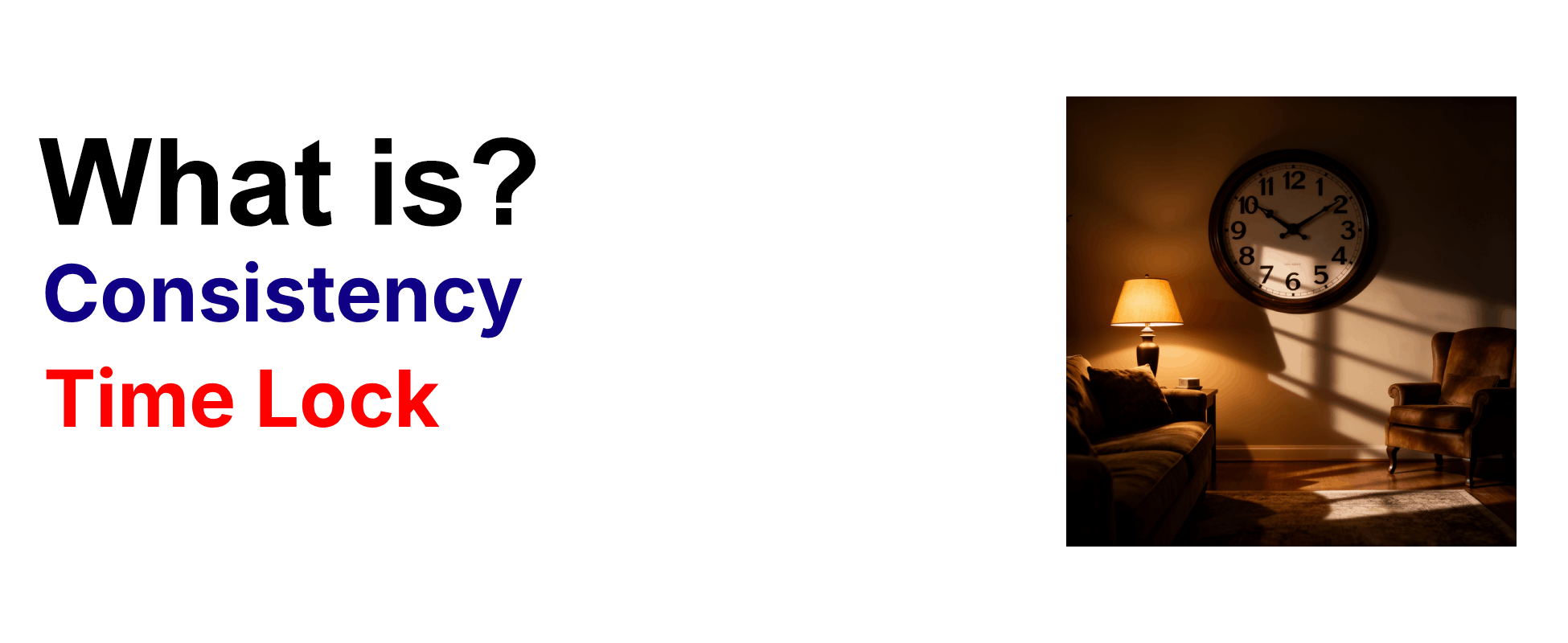
A time lock is a lighting consistency keyword that freezes the sun, moon, or artificial light source at a specific time of day, preventing the AI from arbitrarily shifting the illumination between shots. This technique ensures that shadows, color temperature, and atmospheric mood remain consistent from the first frame to the last, even if the story spans a long period. Directors use a time lock to anchor the timeline, so that a golden hour glow at 18:47 stays true across every angle and every cut, preserving the narrative's emotional rhythm. Without a time lock, the AI may re-roll the position of the sun or moon on each generation, causing shadows to flip, color temperatures to drift, and the visual continuity of a scene to break down.
Example Prompt
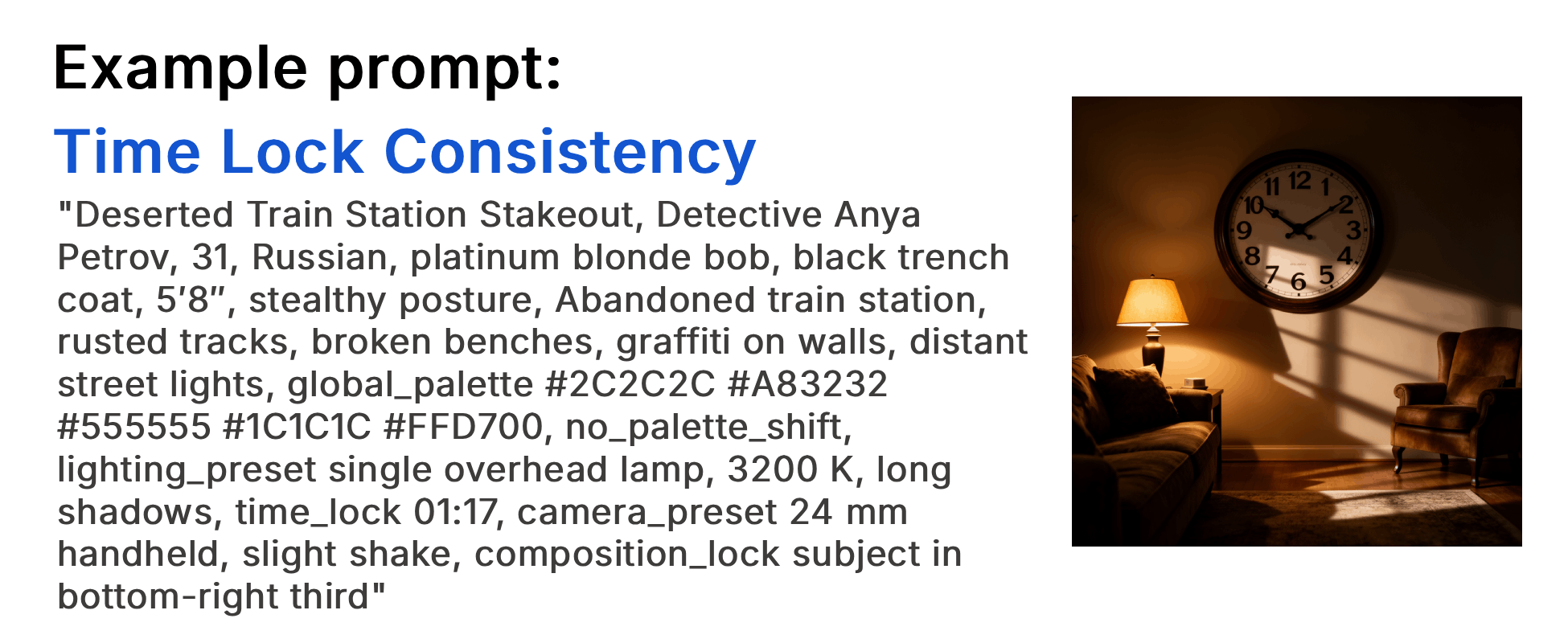
"Deserted Train Station Stakeout, Detective Anya Petrov, 31, Russian, platinum blonde bob, black trench coat, 5′8″, stealthy posture, Abandoned train station, rusted tracks, broken benches, graffiti on walls, distant street lights, global_palette #2C2C2C #A83232 #555555 #1C1C1C #FFD700, no_palette_shift, lighting_preset single overhead lamp, 3200 K, long shadows, time_lock 01:17, camera_preset 24 mm handheld, slight shake, composition_lock subject in bottom-right third"
Prompt Breakdown
| Category | Prompt Text |
|---|---|
| Character consistency | "Detective Anya Petrov, 31, Russian, platinum blonde bob, black trench coat, 5′8″, stealthy posture" |
| Scene consistency | "Abandoned train station, rusted tracks, broken benches, graffiti on walls, distant street lights" |
| Palette consistency | "global_palette #2C2C2C #A83232 #555555 #1C1C1C #FFD700, no_palette_shift" |
| Lighting consistency | "lighting_preset single overhead lamp, 3200 K, long shadows, time_lock 01:17" |
| Camera consistency | "camera_preset 24 mm handheld, slight shake, composition_lock subject in bottom-right third" |
Example Video
When to use a Time Lock?
The time lock technique works best when a scene spans multiple shots that must share the same lighting conditions, such as a conversation filmed from different angles, a chase sequence that unfolds over a short in-story time span, or any multi-cut scene where shadow direction and color temperature must remain identical. It is also essential when your story takes place at a specific time of day, such as golden hour, blue hour, or dead of night, and you want the AI to honor that time across every generation. Avoid using a time lock when the story intentionally progresses through different times of day and the lighting should change naturally to reflect the passage of time.
- Scene spans multiple shots with the same time of day
- Shadow direction and color temperature must stay identical across cuts
- Story takes place during golden hour, blue hour, or nighttime
- A lighting_preset is already defined and needs to be locked in place
- Multi-angle coverage of a single continuous moment
Pros and Cons of the Time Lock
| Pros | Cons |
|---|---|
| Guarantees consistent shadows and color temperature across every shot | Can make a long sequence feel visually monotonous if lighting never changes |
| Prevents the AI from re-rolling sun or moon position between generations | Requires you to know the exact time of day in advance, limiting improvisation |
| Pairs naturally with lighting_preset and global_palette for a full consistency stack | Less effective for stories that span hours or days where light should evolve |
Recommended book

Learn more about AI video editing
Learn more about AI video editing by reading the book How to Make AI Videos by Gyula Rabai. In this book you can find very important information about: Camera Movement, Lighting, Colors, Composition, Consistency, Character emotion, Character motion, Video style, Action Control and Sound design This information will make your videos more professional, and more engaging.
Get your copy here:
https://videcool.com/p_3707-how-to-make-ai-videos-by-gyula-rabai-book.html
Conclusion
The time lock is an essential tool for filmmakers and prompt engineers who need to maintain lighting consistency across multiple AI-generated shots. By freezing the position of the sun, moon, or artificial light source at a precise moment, it ensures that shadows, color temperature, and mood remain true from the first frame to the last. It is not the right choice for every scene, particularly those where lighting should change to reflect the passage of time, but when visual continuity across cuts is the goal, few techniques are as effective. Combined with lighting presets, global palettes, and camera presets, the time lock becomes a powerful anchor in any AI video consistency toolkit.