
AI Video Editing - Action Control - Timing & Beats
Timing and beats is one of the most precise action control techniques available in AI video generation, breaking movement into frame-by-frame phases that give every action believability and dramatic punch. By assigning specific frame ranges to anticipation, release, impact, and follow-through, you can choreograph whether a collision feels monumental or a surprise feels shocking. This page explains what the technique is, when to use it, and how it compares to unstructured action prompting, along with a ready-to-use example prompt.
What is the "Timing & Beats" action control technique?
Timing and beats is a frame-based action control technique that breaks movement into four distinct phases: anticipation, release, impact, and follow-through, each assigned to specific frame ranges for precision control. This approach allows you to choreograph the pacing of actions, such as holding an impact freeze for three frames to make a collision feel monumental or shaving frames off anticipation to turn surprise into shock. Directors use timing and beats to give movements believability and punch, ensuring that every action from a simple gesture to an explosive sequence feels intentional and narratively weighted.
Example Prompt
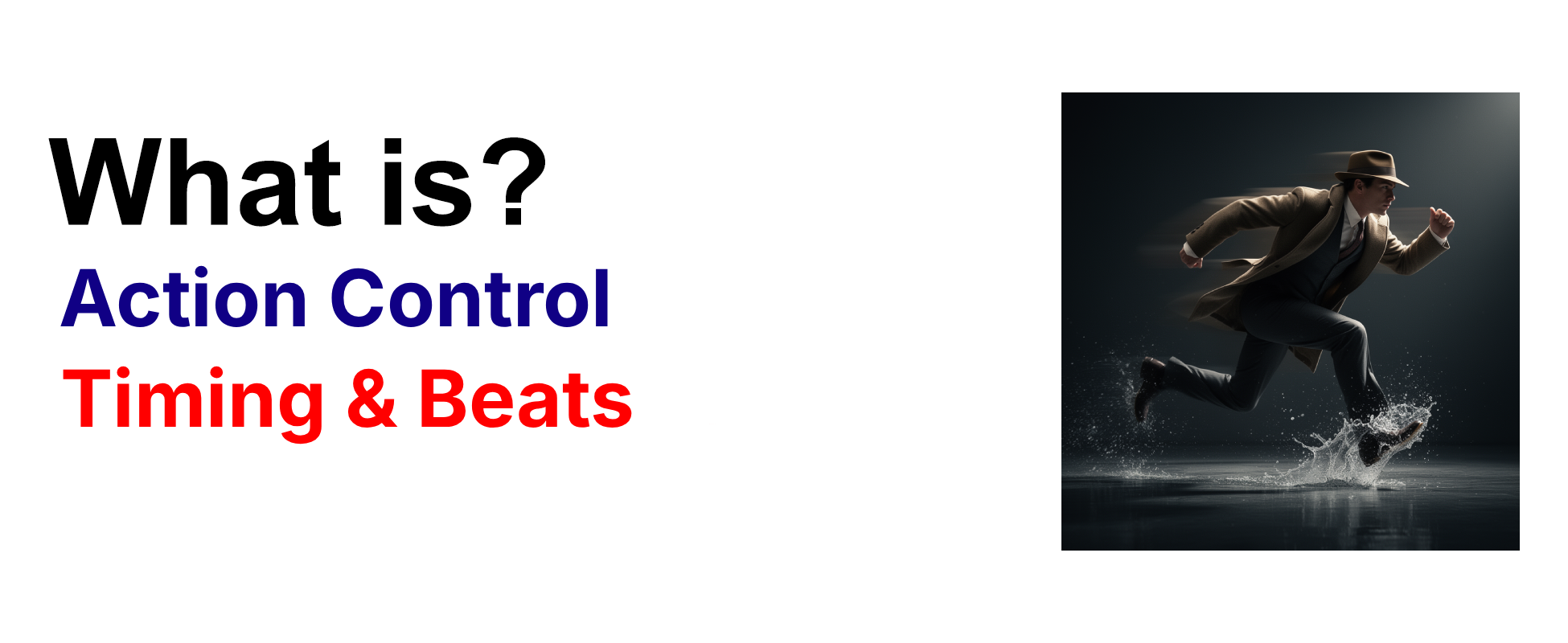
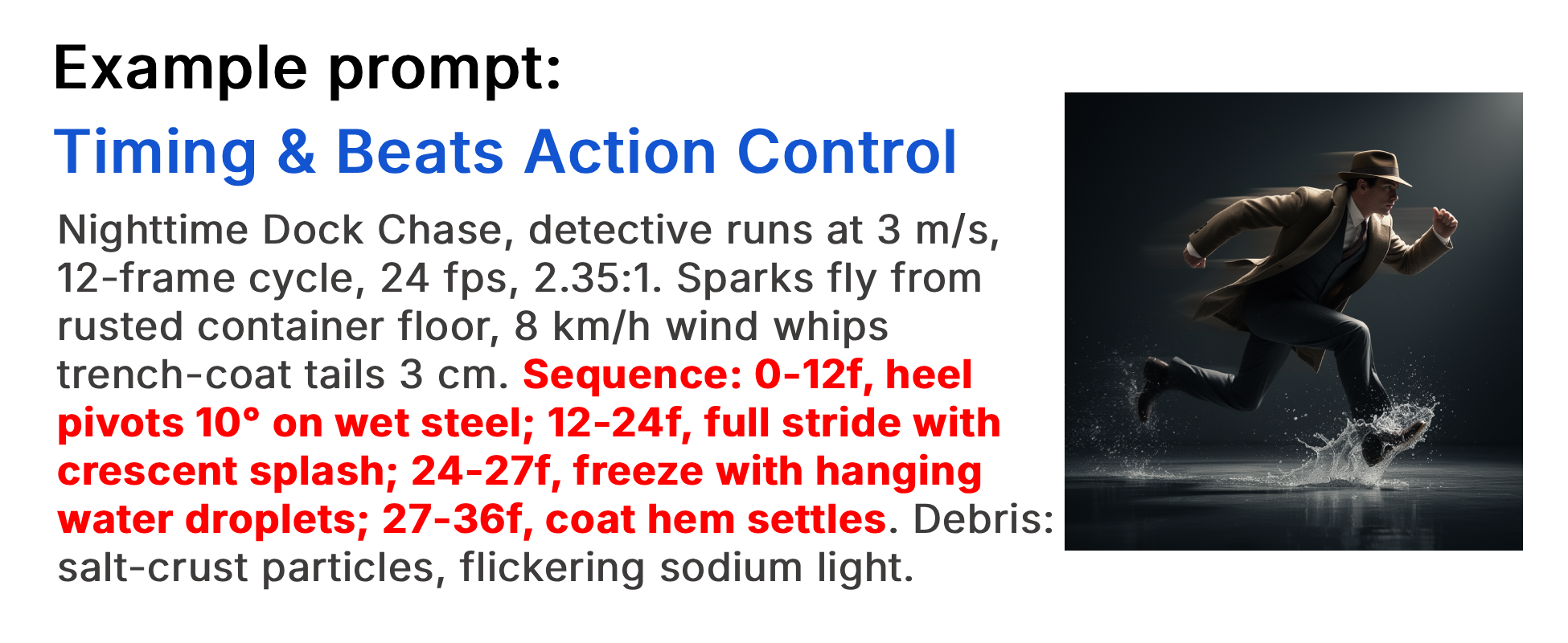
Nighttime Dock Chase, detective runs at 3 m/s, 12-frame cycle, 24 fps, 2.35:1. Sparks fly from rusted container floor, 8 km/h wind whips trench-coat tails 3 cm. Sequence: 0-12f, heel pivots 10° on wet steel; 12-24f, full stride with crescent splash; 24-27f, freeze with hanging water droplets; 27-36f, coat hem settles. Debris: salt-crust particles, flickering sodium light.
Example Video
When to use the Timing & Beats technique?
The timing and beats technique works best when a scene demands precise control over how an action unfolds, such as fight choreography where impact freezes add weight, chase sequences where anticipation builds tension, or dramatic reveals where a well-timed pause creates suspense. It is also essential when you need an action to feel physically believable, since the four-phase structure mirrors how real motion works: wind-up, execution, contact, and settle. Avoid this technique for simple ambient actions or slow, flowing movements where beat-level precision would overcomplicate the prompt without visible benefit.
- Action needs precise frame-by-frame choreography
- Impact or collision moments require dramatic emphasis
- Anticipation should build tension before a release
- Physical believability depends on proper follow-through
- The scene involves rapid, multi-phase movements
Pros and Cons of Timing & Beats
| Pros | Cons |
|---|---|
| Delivers frame-perfect control over how every phase of an action unfolds | Requires understanding of animation principles to use effectively |
| Makes impacts, collisions, and freezes feel dramatically weighty and intentional | Can overcomplicate prompts for simple or slow-moving scenes |
| Provides a reusable structure that works across any action type or intensity | AI models may not always interpret exact frame counts with perfect fidelity |
Recommended book
Learn more about AI video editing
Learn more about AI video editing by reading the book How to Make AI Videos by Gyula Rabai. In this book you can find very important information about: Camera Movement, Lighting, Colors, Composition, Consistency, Character emotion, Character motion, Video style, Action Control and Sound design This information will make your videos more professional, and more engaging.
Get your copy here:
https://videcool.com/p_3707-how-to-make-ai-videos-by-gyula-rabai-book.html
Conclusion
Timing and beats is a powerful tool for filmmakers and prompt engineers who want to give their AI-generated actions believability, weight, and dramatic precision. By breaking movement into anticipation, release, impact, and follow-through phases tied to specific frame ranges, it transforms vague action descriptions into choreographed sequences that feel intentional and narratively compelling. It is not the right choice for every scene, but when physical realism, dramatic emphasis, or precise choreography are the goal, few techniques deliver as effectively. Used thoughtfully alongside intensity modifiers and physics hooks, it becomes a versatile addition to any AI video generation toolkit.