
AI Video Editing - Action Control - Environmental Interactions
Environmental interactions are a powerful action control technique in AI video generation that specifies how a character's movement affects and is affected by their surroundings. By using reactive motion keywords like "splash through puddles" or "wind tousles hair during a sprint," this approach grounds action in a physical world where every movement has visible consequences. This page explains what the technique is, when to use it, and how it compares to other action control approaches, along with a ready-to-use example prompt.
What is the "Environmental Interactions" technique?
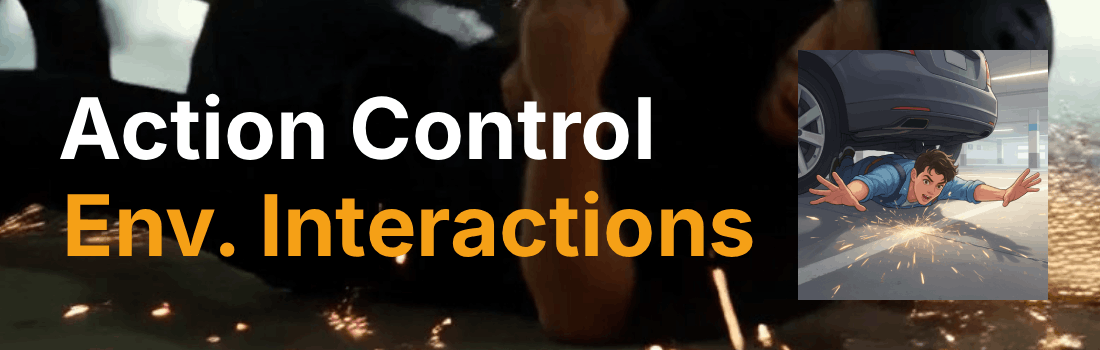
Environmental interactions are action control techniques that specify how a character's movement affects and is affected by their surroundings, using reactive motion keywords like splashing through puddles or dodging falling debris. This approach elevates realism by adding sparks from concrete, wind that tousles hair during a sprint, or debris that scatters on impact, making the action feel grounded in a physical world. Directors use environmental interactions to immerse audiences in the scene, ensuring that every action has consequences on the environment and that the environment actively shapes the action in return. The key technique for environmental interactions is to add reactive motion keywords, such as "dodge falling debris with agile leaps," and to add destructive or constructive keywords, such as "smash through glass" or "gently place object."
Example Prompt
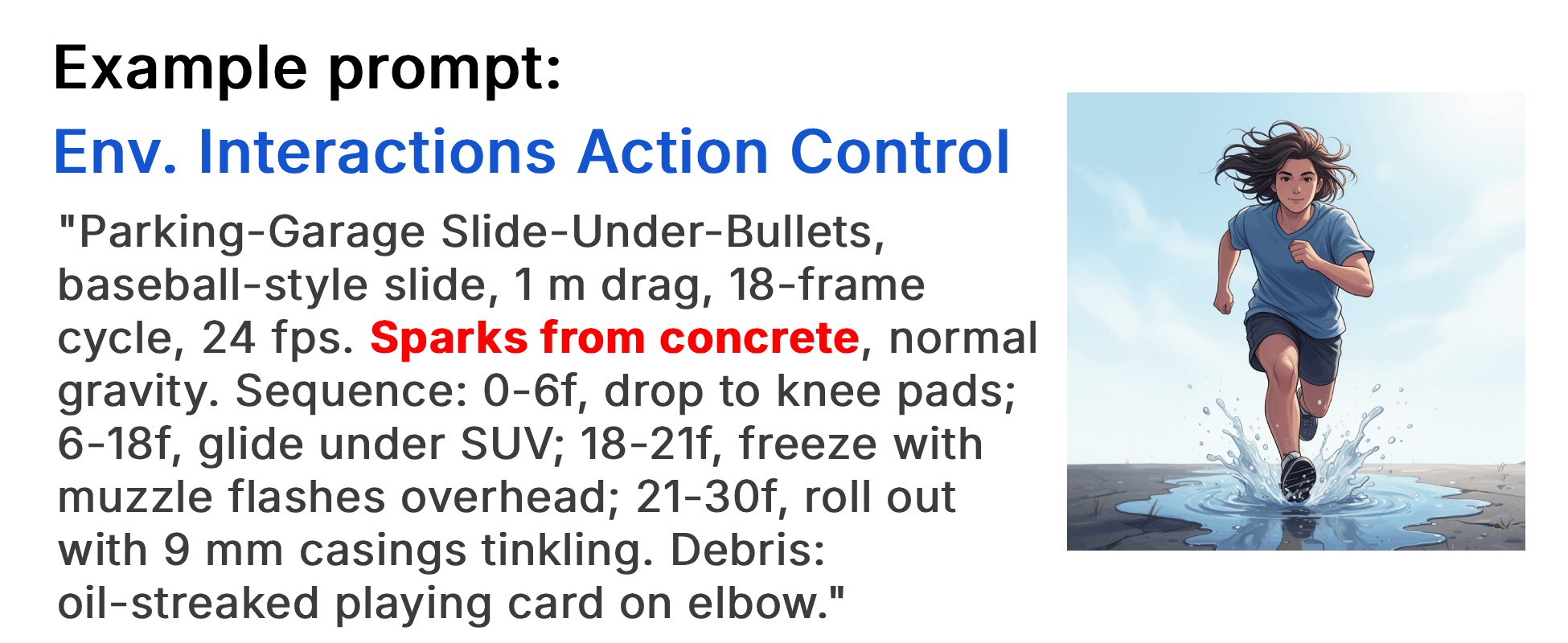
"Parking-Garage Slide-Under-Bullets, baseball-style slide, 1 m drag, 18-frame cycle, 24 fps. Sparks from concrete, normal gravity. Sequence: 0-6f, drop to knee pads; 6-18f, glide under SUV; 18-21f, freeze with muzzle flashes overhead; 21-30f, roll out with 9 mm casings tinkling. Debris: oil-streaked playing card on elbow."
Example Video
When to use the Environmental Interactions technique?
The environmental interactions technique works best when a scene calls for tactile realism and immersive grounding, such as chase sequences through varied terrain, combat in cluttered environments, or any action where the surroundings play an active role in the storytelling. It is also highly effective for outdoor marketing shots and documentary-style footage where the interplay between character and environment sells the authenticity of the moment. Avoid this technique when the environment is irrelevant to the action or when a clean, minimalist aesthetic is desired, as excessive environmental detail can distract from the focal subject.
- The scene takes place in a rich, detailed environment
- Character movement should produce visible environmental effects
- The action involves debris, water, wind, or other physical elements
- Immersion and realism are more important than a clean aesthetic
- The environment actively shapes or constrains the character's movement
Pros and Cons of Environmental Interactions
| Pros | Cons |
|---|---|
| Grounds action in a believable physical world, increasing immersion | Can overload a scene with too much detail, distracting from the main subject |
| Adds tactile feedback (sparks, dust, splashes) that makes impacts feel real | Requires careful keyword pairing; mismatched effects can look unnatural |
| Reactive motion keywords create a dynamic interplay between character and setting | May increase render complexity and generation time due to particle simulations |
Recommended book

Learn more about AI video editing
Learn more about AI video editing by reading the book How to Make AI Videos by Gyula Rabai. In this book you can find very important information about: Camera Movement, Lighting, Colors, Composition, Consistency, Character emotion, Character motion, Video style, Action Control and Sound design This information will make your videos more professional, and more engaging.
Get your copy here:
https://videcool.com/p_3707-how-to-make-ai-videos-by-gyula-rabai-book.html
Conclusion
Environmental interactions are a powerful tool for filmmakers and prompt engineers who want to ground their AI-generated action in a believable, tactile world. By specifying how characters affect and are affected by their surroundings, through sparks, debris, wind, water, and other reactive elements, you transform isolated movements into immersive moments that feel physically real. It is not the right choice for every scene, but when realism, immersion, and environmental storytelling are the goal, few techniques communicate them as effectively. Used thoughtfully alongside other action control techniques like intensity modifiers and timing beats, environmental interactions become a versatile addition to any AI video generation toolkit.