
AI Video Editing - Character Emotion - Building Sad
Building Sad is one of the most emotionally powerful character emotion techniques available in AI video generation, transforming a single tear into a full-body expression of grief that unfolds across frames. This progressive escalation mirrors the way real human sorrow builds over time, creating an emotional arc that needs no dialogue to land. This page explains what the technique is, when to use it, and how it compares to other emotion intensities, along with a ready-to-use example prompt.

What is the "Building Sad" emotion technique?
Building Sad is an emotional progression where the character's grief escalates across frames, starting with subtle signs like a single tear and evolving into a full sob with downturned lips, trembling chin, and slow, heavy blinks. This gradual crescendo mirrors the human experience of grief that intensifies as painful memories surface, creating a powerful emotional arc without a single word of dialogue. Directors use building sad for flashback sequences, revelations of loss, or moments where a character's carefully maintained composure finally crumbles under the weight of buried pain. In AI prompting, the "building" intensity modifier tells the model to choreograph the emotion across consecutive frames rather than rendering it at full intensity from the start, giving the performance a natural, believable arc that deepens with every cut.

Example Prompt
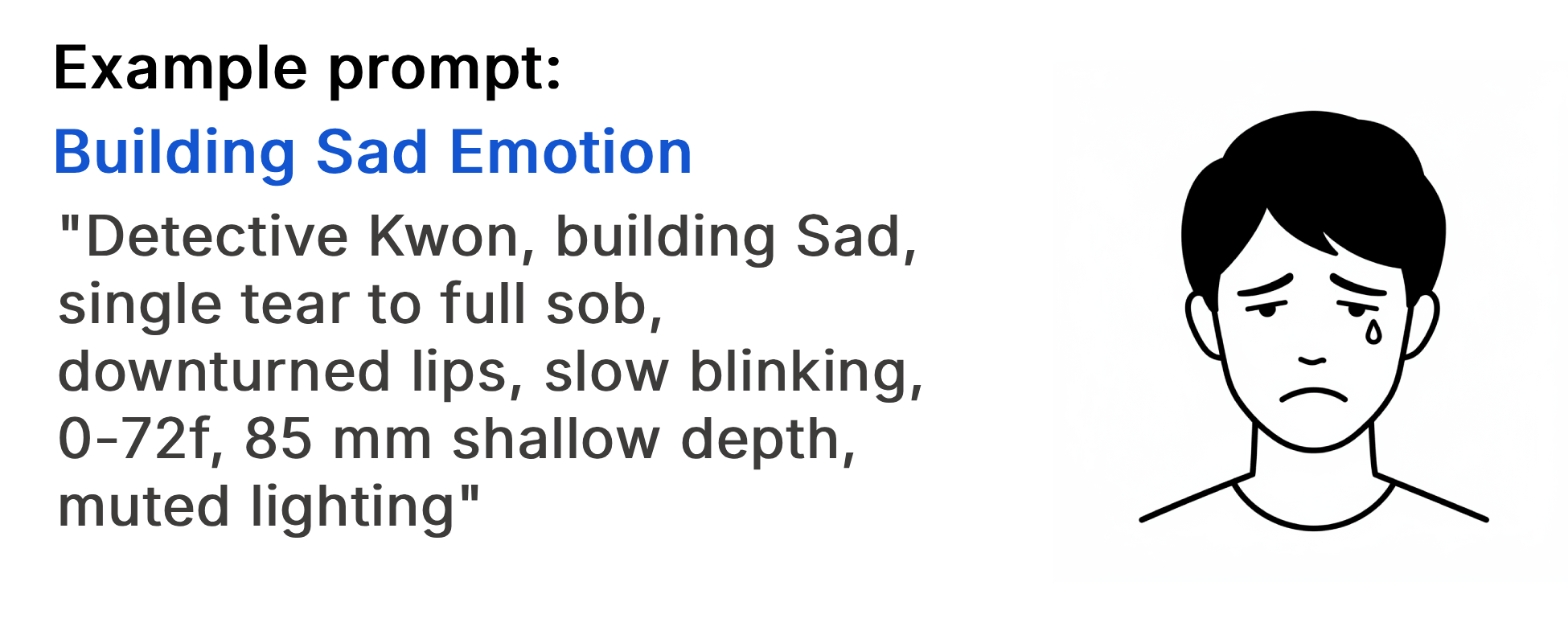
Emotion prompt: Detective Kwon, building Sad, single tear to full
sob, downturned lips, slow blinking, 0-72f, 85 mm shallow depth,
muted lighting
Scenario prompt: A flashback triggers emotional pain. Detective
Kwon's grief gradually escalates, reflecting internal struggle
without dialogue.
Example Video
When to use the Building Sad technique?
The Building Sad technique works best when a scene calls for a gradual emotional escalation, such as flashback sequences where painful memories resurface, moments of loss or grief that need to deepen over time, or scenes where a character's composure slowly cracks under emotional pressure. It is also effective for revelation scenes where the full weight of a tragic truth sinks in progressively, allowing the audience to feel each stage of the character's pain. Avoid this technique for scenes that require instant emotional impact, where a sudden burst of sadness (intense Sad) will better serve the moment, or for fast-paced action sequences where a slow emotional build would disrupt the rhythm.
- Flashback sequences revealing painful memories
- A character's composure gradually crumbles
- Grief or loss needs to deepen across frames
- A revelation's emotional weight sinks in slowly
- The scene benefits from a dialogue-free emotional arc
Pros and Cons of the Building Sad
| Pros | Cons |
|---|---|
| Creates a powerful, believable emotional arc without any dialogue | Can feel melodramatic if the escalation is too slow or overused |
| Mirrors authentic human grief progression for deep viewer connection | Requires precise frame timing cues to look natural and convincing |
| Builds narrative tension through gradual, layered escalation | Subtle early stages may be missed on small screens or low resolution |
Recommended book

Learn more about AI video editing
Learn more about AI video editing by reading the book How to Make AI Videos by Gyula Rabai. In this book you can find very important information about: Camera Movement, Lighting, Colors, Composition, Consistency, Character emotion, Character motion, Video style, Action Control and Sound design This information will make your videos more professional, and more engaging.
Get your copy here:
https://videcool.com/p_3707-how-to-make-ai-videos-by-gyula-rabai-book.html
Conclusion
The Building Sad technique is a powerful tool for filmmakers and prompt engineers who want to portray grief that deepens organically across frames. By choreographing the escalation from a single tear to a full sob, it gives digital characters a believable emotional arc that resonates with viewers on a deeply human level. It is not the right choice for every scene, but when flashback pain, crumbling composure, or progressive loss are the goal, few techniques communicate them as effectively. Used thoughtfully alongside other emotion intensities and timing cues, it becomes a versatile addition to any AI video generation toolkit.