
AI Video Editing - Camera Movement - Push-in
A push-in is one of the most psychologically direct camera movements available in AI video generation, physically closing the distance between the camera and its subject to build tension or reveal an emotional turning point. This page explains what the technique is, when to use it, and how it compares to other camera movements, along with a ready-to-use example prompt.
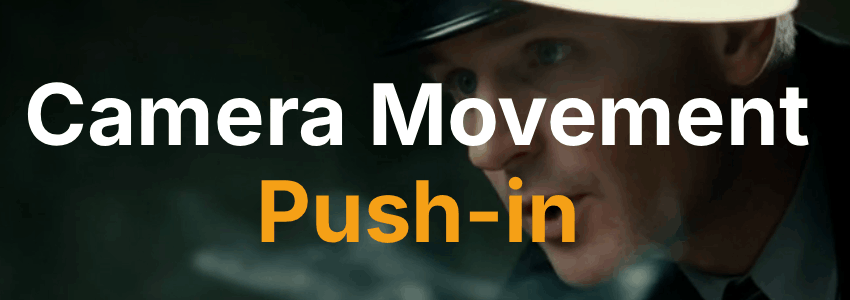
What is the "Push-In" camera technique?
A camera push-in is a physical movement where the entire camera rig glides forward towards the subject, literally invading their spatial boundaries to create a mounting sense of psychological intensity or revelation. Unlike a zoom, which flattens space and feels like an optical telescope, the push-in dynamically alters the perspective by shifting the background past the subject, making the environment feel as though it's closing in. As a filmmaker, you deploy this tool not just to see a character better, but to force the audience into their emotional state, transforming an external observation into an internal, inescapable confrontation.
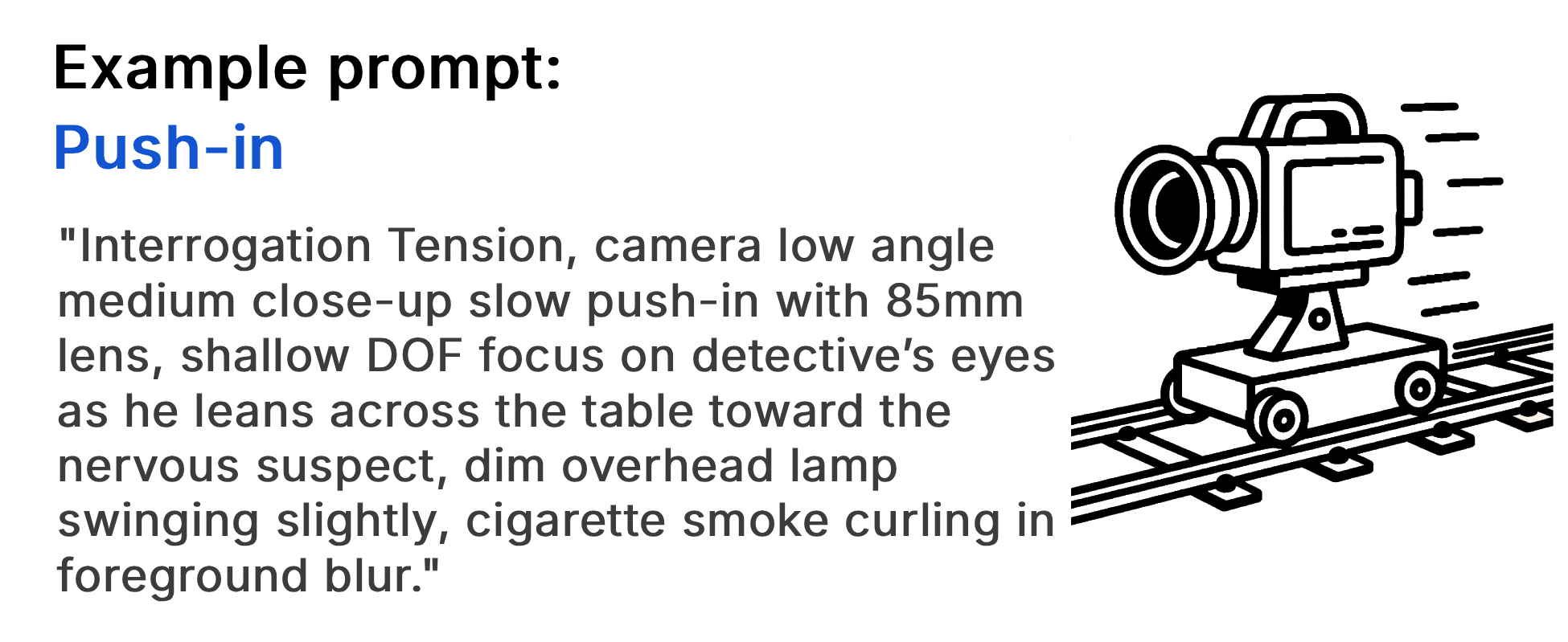
Example Prompt
"Interrogation Tension, camera low angle medium close-up slow push-in with 85mm lens, shallow DOF focus on detective's eyes as he leans across the table toward the nervous suspect, dim overhead lamp swinging slightly, cigarette smoke curling in foreground blur."
Example Video
When to use the Push-In technique?
The push-in technique works best when a scene calls for mounting psychological tension, a moment of realization, or an emotional turning point, such as interrogations, confrontations, or quiet instances of dawning fear or clarity. It is also effective for gradually narrowing the audience's focus onto a single detail, turning a wide observation into an intimate one. Avoid this technique for scenes that need to stay emotionally distant or expansive, where holding a static or wider shot will better preserve the sense of space.
- Scene needs mounting tension
- A character reaches a turning point
- Focus should narrow to a single detail
- To build emotion gradually
- When slow, steady pacing fits the moment
Pros and Cons of the Push-In
| Pros | Cons |
|---|---|
| Builds psychological tension smoothly and deliberately | Can feel slow or unnecessary in fast-paced or action-driven scenes |
| Directs audience focus precisely onto a character's emotional state | Requires careful pacing, since a mistimed push-in can feel heavy-handed |
| Reshapes depth and perspective more naturally than a zoom | Less effective at conveying urgency compared to handheld or tracking shots |
Recommended book
Learn more about AI video editing
Learn more about AI video editing by reading the book How to Make AI Videos by Gyula Rabai. In this book you can find very important information about: Camera Movement, Lighting, Colors, Composition, Consistency, Character emotion, Character motion, Video style, Action Control and Sound design This information will make your videos more professional, and more engaging.
Get your copy here:
https://videcool.com/p_3707-how-to-make-ai-videos-by-gyula-rabai-book.html
Conclusion
The push-in is a powerful tool for filmmakers and prompt engineers who want to deepen emotional intensity without resorting to fast or chaotic motion. By closing the physical distance between the camera and its subject, it turns passive viewing into an inescapable, internal confrontation with a character's state of mind. It is not the right choice for every scene, but when tension, revelation, or quiet dread are the goal, few techniques communicate them as precisely. Used thoughtfully alongside faster or more energetic camera movements, it becomes a versatile addition to any AI video generation toolkit.