
AI Video Editing - Camera Movement - Slow Push-In
A slow push-in is one of the most understated camera movements available in AI video generation, easing the camera toward its subject so gradually that the audience feels the tension build without ever noticing the technique itself. This page explains what the technique is, when to use it, and how it compares to other camera movements, along with a ready-to-use example prompt.
What is the "Slow Push-In" camera technique?
A slow push-in is a gradual forward movement of the camera toward the subject, typically achieved with a dolly or a steady rig, that subtly increases the subject's visual weight within the frame. This unhurried approach draws the audience's attention deeper into the scene without announcing itself as a dramatic gesture, allowing the tension or emotional intensity to build organically. Directors employ a slow push-in to signal a character's realization, to create intimacy with a subject, or to intensify the psychological pressure of a moment without resorting to rapid cuts or quick motion.
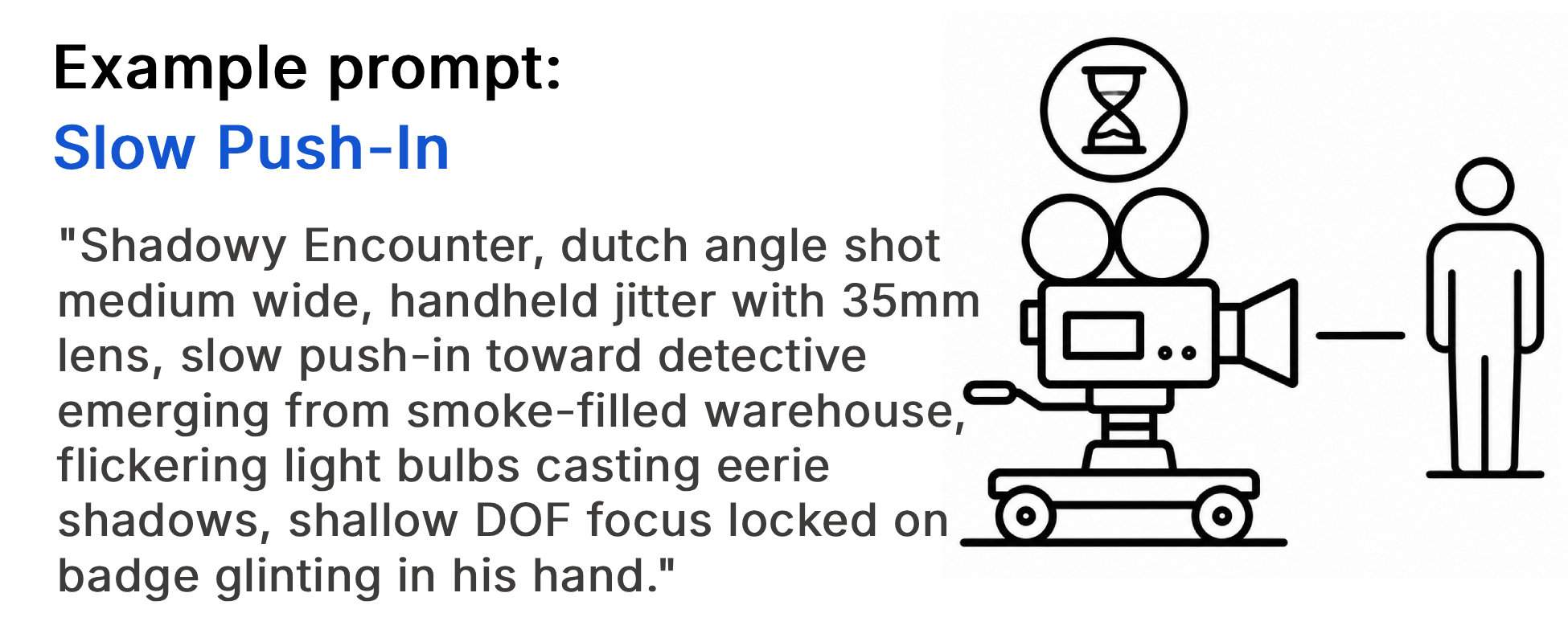
Example Prompt
"Shadowy Encounter, dutch angle shot medium wide, handheld jitter with 35mm lens, slow push-in toward detective emerging from smoke-filled warehouse, flickering light bulbs casting eerie shadows, shallow DOF focus locked on badge glinting in his hand."
Example Video
When to use the Slow Push-In technique?
The slow push-in technique works best when a scene calls for gradual emotional build, such as a character's slow realization, quiet dread, or a moment of intimacy that shouldn't feel rushed. It is also effective when you want the audience to feel tension mounting without drawing attention to the camera work itself. Avoid this technique for scenes that need a sudden jolt of intensity or urgency, where a faster push-in or handheld movement will better convey immediacy.
- The scene needs a gradual emotional build
- Awareness builds quietly over the shot
- An intimate moment shouldn't feel rushed
- Pressure builds quietly in the background
- There's time for the shot to unfold slowly
Pros and Cons of the Slow Push-In
| Pros | Cons |
|---|---|
| Builds tension gradually without calling attention to the camera | Too subtle for scenes that need immediate emotional impact |
| Creates a strong sense of intimacy and psychological pressure | Requires a longer take, which may not fit fast-paced editing |
| Feels natural and unforced compared to a sudden push-in | Can lose the audience's attention if the pacing drags |
Recommended book
Learn more about AI video editing
Learn more about AI video editing by reading the book How to Make AI Videos by Gyula Rabai. In this book you can find very important information about: Camera Movement, Lighting, Colors, Composition, Consistency, Character emotion, Character motion, Video style, Action Control and Sound design This information will make your videos more professional, and more engaging.
Get your copy here:
https://videcool.com/p_3707-how-to-make-ai-videos-by-gyula-rabai-book.html
Conclusion
The slow push-in is a powerful tool for filmmakers and prompt engineers who want to build tension or intimacy without ever letting the camera work announce itself. By easing forward rather than pushing hard, it lets a scene's emotional weight accumulate naturally, giving realizations and quiet dread room to breathe. It is not the right choice for every scene, but when patience and subtlety are the goal, few techniques communicate them as effectively. Used thoughtfully alongside faster, more assertive camera movements, it becomes a versatile addition to any AI video generation toolkit.