
AI Video Editing - Camera Movement - Static Camera
A static camera is one of the most restrained camera techniques available in AI video generation, removing all motion so the audience's attention rests entirely on what happens inside the frame. This page explains what the technique is, when to use it, and how it compares to more dynamic alternatives, along with a ready-to-use example prompt.
What is the "Static Camera" camera technique?
A static camera is a camera that remains completely motionless on a fixed support, with no pan, tilt, dolly, or any other movement during the take. This absolute stillness shifts the audience's focus entirely to the action within the frame, making every subtle gesture or environmental change more pronounced. Directors choose a static camera to convey stillness, introspection, or to let the scene's internal tension build without any cinematic distraction from the camera itself.
Example Prompt
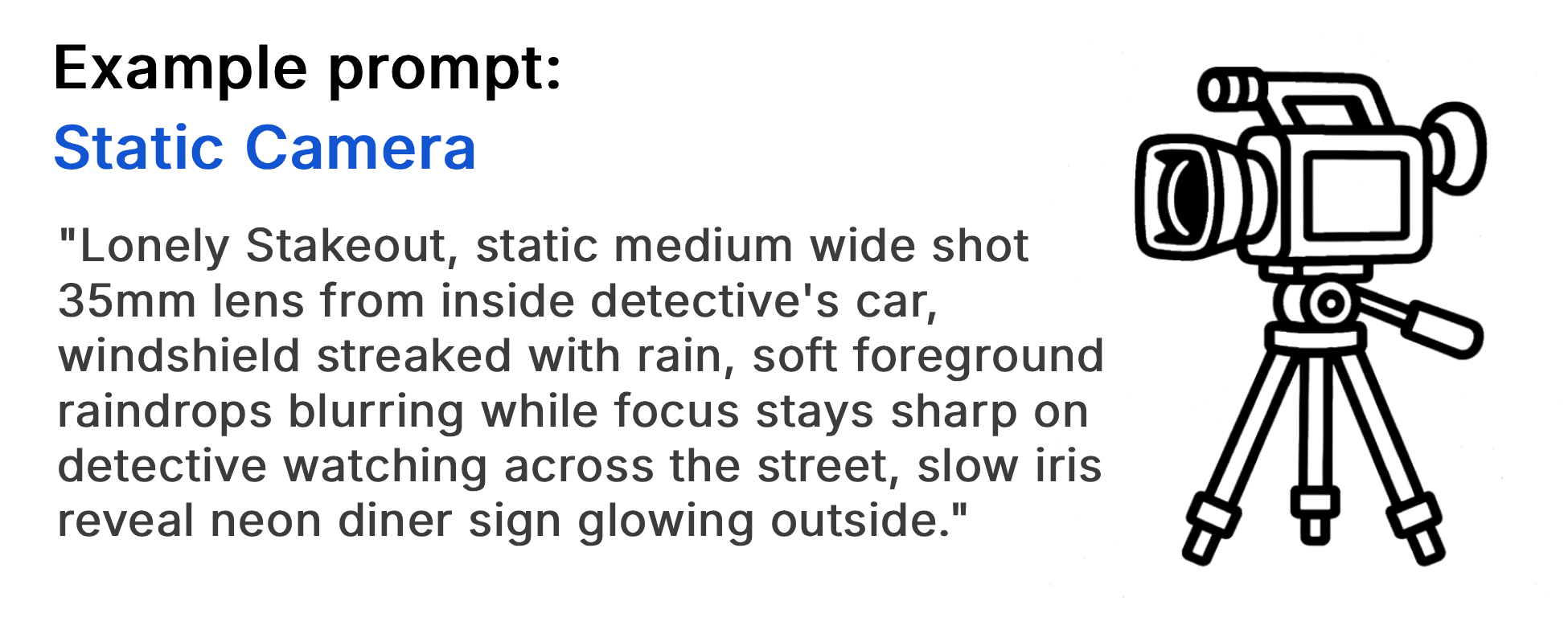
"Lonely Stakeout, static medium wide shot 35mm lens from inside detective's car, windshield streaked with rain, soft foreground raindrops blurring while focus stays sharp on detective watching across the street, slow iris reveal neon diner sign glowing outside."
Example Video
When to use the Static Camera technique?
The static camera technique works best when a scene calls for quiet tension, patience, or introspection, such as stakeouts, waiting rooms, or moments where a character sits with their own thoughts. It is also effective for letting small details, like a flickering sign or a hand tightening on a steering wheel, carry the full weight of the scene without competing against camera motion. Avoid this technique for scenes that need urgency or physical energy, where a moving camera will better convey the pace of the action.
- The moment calls for patience, not motion
- A character is waiting or watching
- A quiet, internal moment is unfolding
- A subtle gesture needs full attention
- No movement should distract from the action
Pros and Cons of the Static Camera
| Pros | Cons |
|---|---|
| Keeps full attention on the subject without any distracting motion | Can feel flat or uneventful in scenes that need visual energy |
| Builds patience and tension through stillness and restraint | Relies heavily on strong composition, since there's no movement to help the frame |
| Simple and predictable to set up compared to moving camera rigs | Less effective at conveying urgency, chaos, or fast-paced action |
Recommended book
Learn more about AI video editing
Learn more about AI video editing by reading the book How to Make AI Videos by Gyula Rabai. In this book you can find very important information about: Camera Movement, Lighting, Colors, Composition, Consistency, Character emotion, Character motion, Video style, Action Control and Sound design This information will make your videos more professional, and more engaging.
Get your copy here:
https://videcool.com/p_3707-how-to-make-ai-videos-by-gyula-rabai-book.html
Conclusion
The static camera is a powerful tool for filmmakers and prompt engineers who want to let a scene breathe without the distraction of movement. By holding perfectly still, it puts every gesture, glance, and environmental detail under quiet scrutiny, turning patience itself into a storytelling device. It is not the right choice for every scene, but when introspection, tension, or restraint are the goal, few techniques communicate them as effectively. Used thoughtfully alongside more dynamic camera movements, it becomes a versatile addition to any AI video generation toolkit.