
AI Video Editing - Sound-Design - Ambience
Ambience is the invisible foundation of every immersive soundscape, providing the constant environmental bed that makes a scene feel real and emotionally resonant. From the distant hum of a city at night to the gentle rustle of leaves in a forest, ambience surrounds the viewer with a sense of place without ever demanding attention. This page explains what ambience is, when to use it, and how it compares to other sound types, along with a ready-to-use example prompt.
What is Ambience?
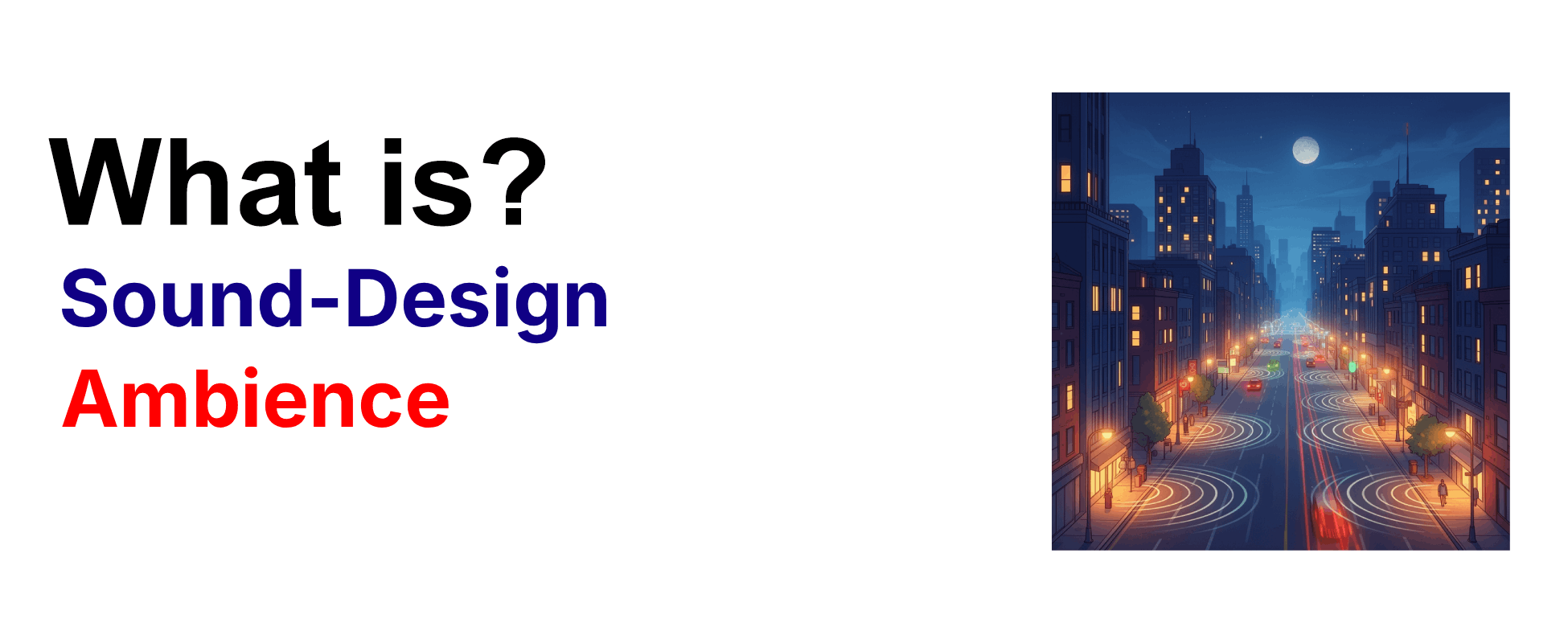
Ambience is a primary sound type that establishes the world-building bed of a scene, providing the constant, low-level environmental sounds like city hum, wind, or dripping water that create a sense of place and emotional atmosphere. This sonic foundation sits in the background at a subtle volume, often around -18 LUFS, and supports the narrative without demanding active attention from the audience. Directors use ambience to immerse viewers in the location, making the environment feel alive and emotionally resonant whether it is a peaceful forest or a tense, rain-slicked city street.
Example Prompt
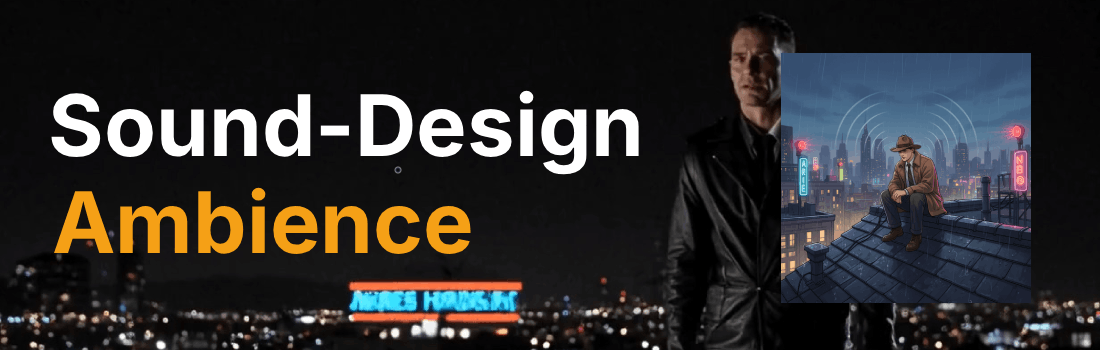
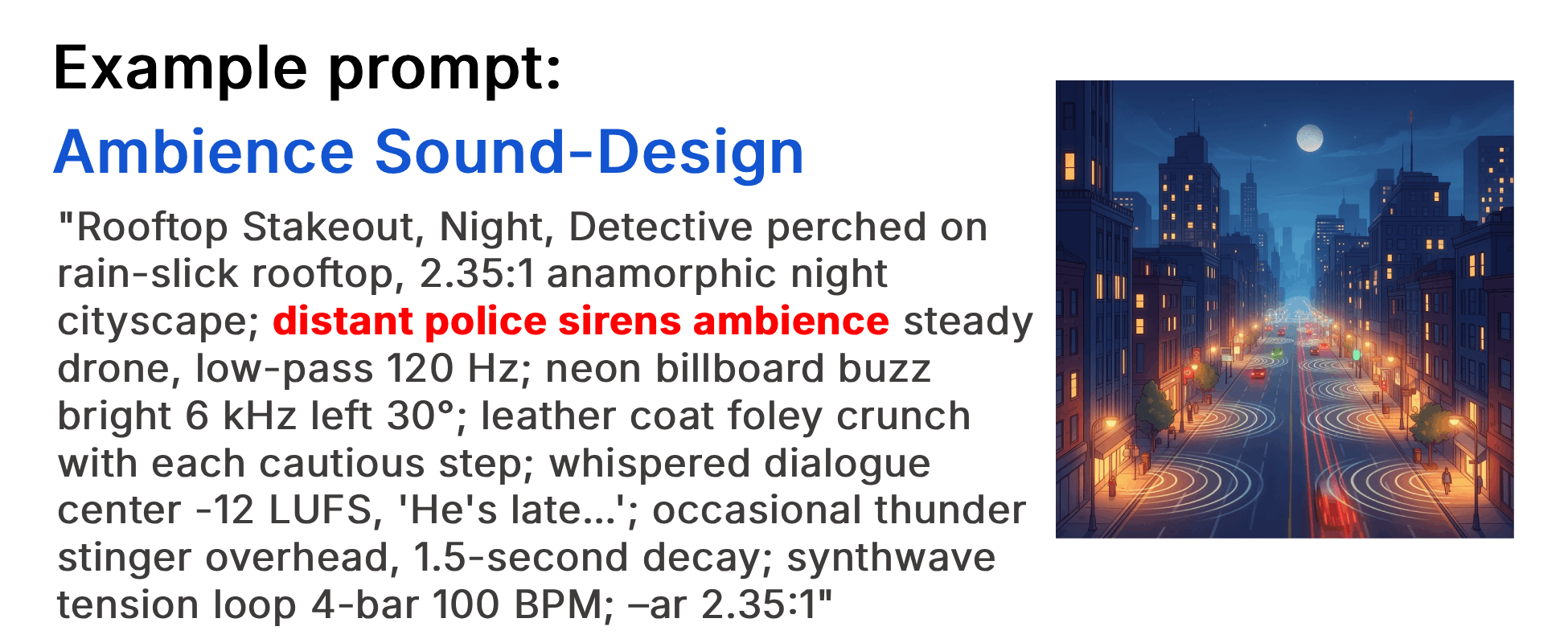
"Rooftop Stakeout, Night, Detective perched on rain-slick rooftop, 2.35:1 anamorphic night cityscape; distant police sirens ambience steady drone, low-pass 120 Hz; neon billboard buzz bright 6 kHz left 30°; leather coat foley crunch with each cautious step; whispered dialogue center -12 LUFS, 'He's late…'; occasional thunder stinger overhead, 1.5-second decay; synthwave tension loop 4-bar 100 BPM; –ar 2.35:1"
Example Video
When to use Ambience?
Ambience works best when a scene needs to establish a believable sense of place, ground the viewer in a specific location, or fill the sonic space between dialogue and action with atmospheric texture. It is ideal for opening establishing shots, transitions between scenes, and any moment where the environment itself becomes a character in the story. Use ambience to suggest time of day, weather, or social context without a single line of dialogue. Avoid relying on ambience alone in fast-paced action sequences where punchy sound effects and music should dominate the mix, or in scenes where silence is deliberately used for dramatic tension.
- The scene needs a believable sense of place
- An establishing shot introduces a new location
- The environment should feel alive without dialogue
- A transition between scenes requires atmospheric continuity
- The mood depends on environmental texture like weather or city noise
Pros and Cons of Ambience
| Pros | Cons |
|---|---|
| Creates an immersive, believable sense of place with minimal effort | Can feel flat or empty if used alone without supporting sound layers |
| Sits naturally in the background without competing with dialogue or music | Too much ambience can muddy the mix and reduce clarity of key sounds |
| Conveys mood, time of day, and weather without explicit narration | Requires careful LUFS management to avoid overwhelming subtle scenes |
Recommended book

Learn more about AI video editing
Learn more about AI video editing by reading the book How to Make AI Videos by Gyula Rabai. In this book you can find very important information about: Camera Movement, Lighting, Colors, Composition, Consistency, Character emotion, Character motion, Video style, Action Control and Sound design This information will make your videos more professional, and more engaging.
Get your copy here:
https://videcool.com/p_3707-how-to-make-ai-videos-by-gyula-rabai-book.html
Conclusion
Ambience is the unsung hero of sound design, the quiet foundation upon which every other sonic element rests. By establishing a believable sense of place at a subtle volume, it immerses the viewer in the world of the scene without ever drawing attention to itself. It is not the right choice for every moment — silence and punchy effects have their place — but when world-building, mood, and atmospheric depth are the goal, few sound types communicate them as effectively. Used thoughtfully alongside dialogue, music, and foley, ambience becomes an essential addition to any AI video sound design toolkit.