
AI Video Editing - Sound-Design - Foley
Foley is the heartbeat of realism in AI video sound design, breathing life into every footstep, fabric rustle, and object interaction on screen. By capturing the tactile sounds of characters engaging with their environment, foley transforms a visually stunning scene into a fully believable, lived-in world. This page explains what foley is, when to use it, and how it compares to other sound types, along with a ready-to-use example prompt.
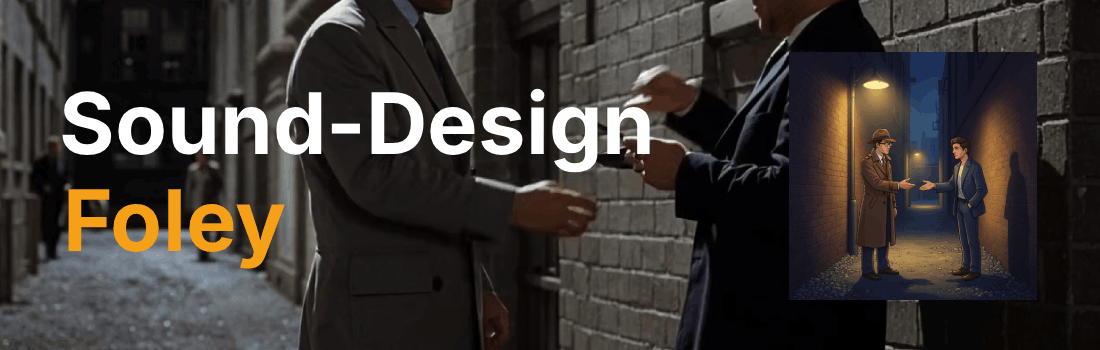
What is Foley?
Foley is a primary sound type that captures the tactile, realistic sounds of characters interacting with their environment and clothing, such as footsteps, fabric rustling, or objects being handled, to add a layer of physical authenticity to the scene. These sounds are typically crisp and present, with a punchy texture that gives the audience a sense of touch and weight in every movement. Directors use foley to make the world feel tangible and lived-in, from the creak of a leather jacket to the crunch of gravel underfoot, grounding the visual action in a believable sonic reality. In AI sound design, foley prompts can specify texture, spatial position, and intensity to guide the model toward generating sounds that feel physically convincing and narratively purposeful.

Example Prompt
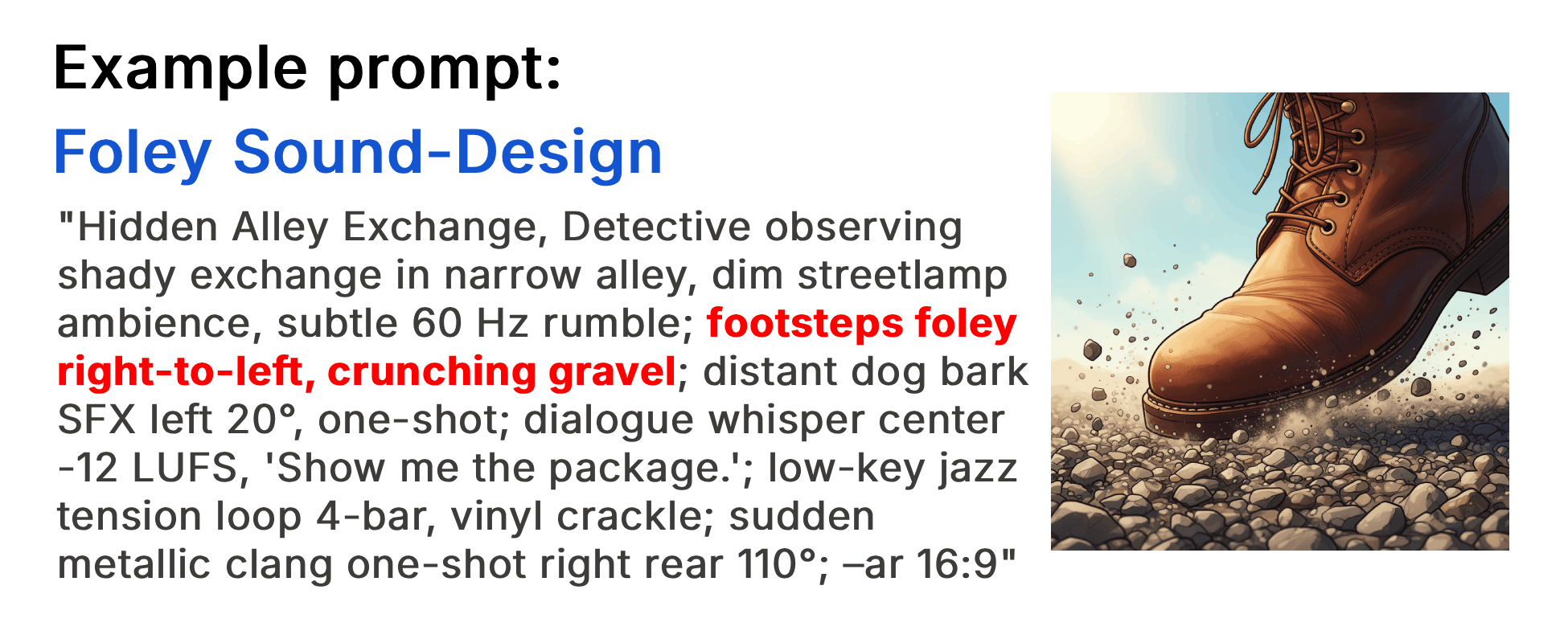
"Hidden Alley Exchange, Detective observing shady exchange in narrow alley, dim streetlamp ambience, subtle 60 Hz rumble; footsteps foley right-to-left, crunching gravel; distant dog bark SFX left 20°, one-shot; dialogue whisper center -12 LUFS, 'Show me the package.'; low-key jazz tension loop 4-bar, vinyl crackle; sudden metallic clang one-shot right rear 110°; –ar 16:9"
Example Video
When to use Foley?
Foley works best when a scene needs to feel grounded, tactile, and physically real. Use it whenever characters interact with objects or their environment in ways the audience should hear and feel — footsteps on different surfaces, the rustle of clothing during movement, the click of a door handle, or the scrape of a chair across a floor. Foley is especially powerful in close-up shots where subtle sounds heighten immersion, in action sequences where impact and motion drive the energy, and in quiet moments where a single creak or rustle can build tension. Avoid overloading every scene with foley; in wide establishing shots or abstract, dreamlike sequences, ambient beds and music may serve the story better than detailed tactile sounds.
- Characters interact with objects or surfaces the audience should feel
- Close-up shots demand tactile, intimate sound detail
- Footsteps or clothing movement need to match on-screen action
- Action sequences require crisp, punchy impact sounds
- Quiet, tense moments benefit from a single telling sound
Pros and Cons of Foley
| Pros | Cons |
|---|---|
| Grounds the scene in physical realism, making the world feel lived-in and believable | Can clutter the mix if too many foley layers compete for the listener's attention |
| Heightens immersion by matching sound to visible movement, reinforcing what the eye sees | Requires careful LUFS balancing so foley does not overpower dialogue or music |
| Excellent for building tension in quiet scenes through subtle, telling sounds | May feel artificial if generated sounds do not precisely match the on-screen action |
Recommended book

Learn more about AI video editing
Learn more about AI video editing by reading the book How to Make AI Videos by Gyula Rabai. In this book you can find very important information about: Camera Movement, Lighting, Colors, Composition, Consistency, Character emotion, Character motion, Video style, Action Control and Sound design This information will make your videos more professional, and more engaging.
Get your copy here:
https://videcool.com/p_3707-how-to-make-ai-videos-by-gyula-rabai-book.html
Conclusion
Foley is an essential tool for filmmakers and prompt engineers who want to make their AI-generated videos feel physically real and emotionally immersive. By describing the tactile sounds of movement, contact, and interaction with precision — specifying texture, spatial position, and intensity — you can guide AI sound models to produce foley that grounds every scene in a believable sonic reality. It is not the right choice for every moment, but when realism, immersion, or tension are the goal, few sound types communicate them as effectively. Used thoughtfully alongside ambience, music, and dialogue, foley becomes a versatile and indispensable part of any AI video sound design toolkit.