
AI Image to image Qwen 2509 ComfyUI workflow for Videcool
The Qwen 2509 image edit workflow in Videcool offers a practical way to modify an existing image with prompt-guided editing by using a compact ComfyUI pipeline built for image-to-image generation. It loads the Qwen 2509 image model and the required supporting components, then transforms an input image into a newly edited version through latent encoding, prompt conditioning, sampling, and image decoding.
What can this ComfyUI workflow do?
In short: prompt-based image editing with Qwen 2509.
This workflow accepts an existing input image, encodes it into latent space, applies text guidance that describes the desired change, performs the edit through sampling, decodes the result back into image space, and saves the final generated output for use in Videcool.
Example usage in Videcool
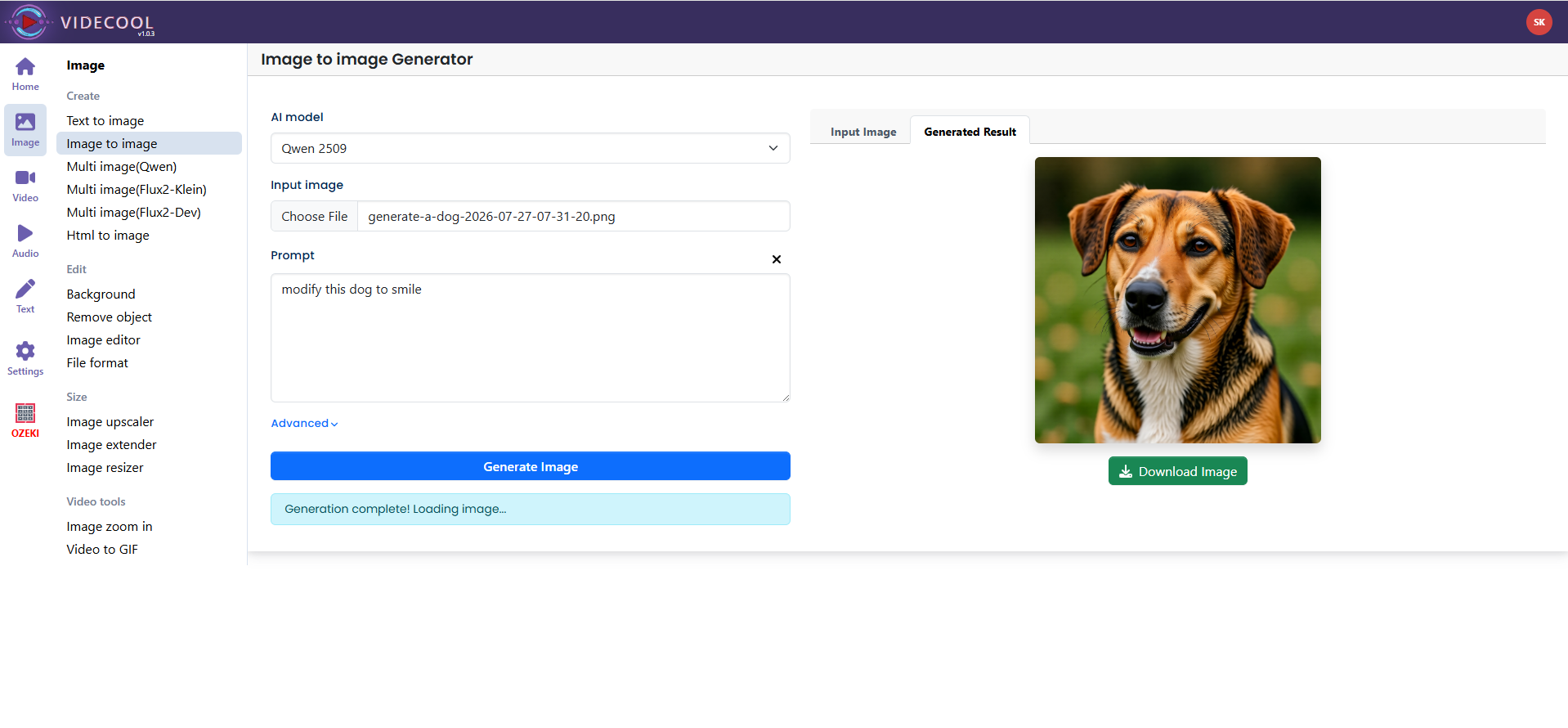
Download the ComfyUI workflow
Download ComfyUI Workflow file: qwen_2509_image_to_image-api.json
Image of the ComfyUI workflow
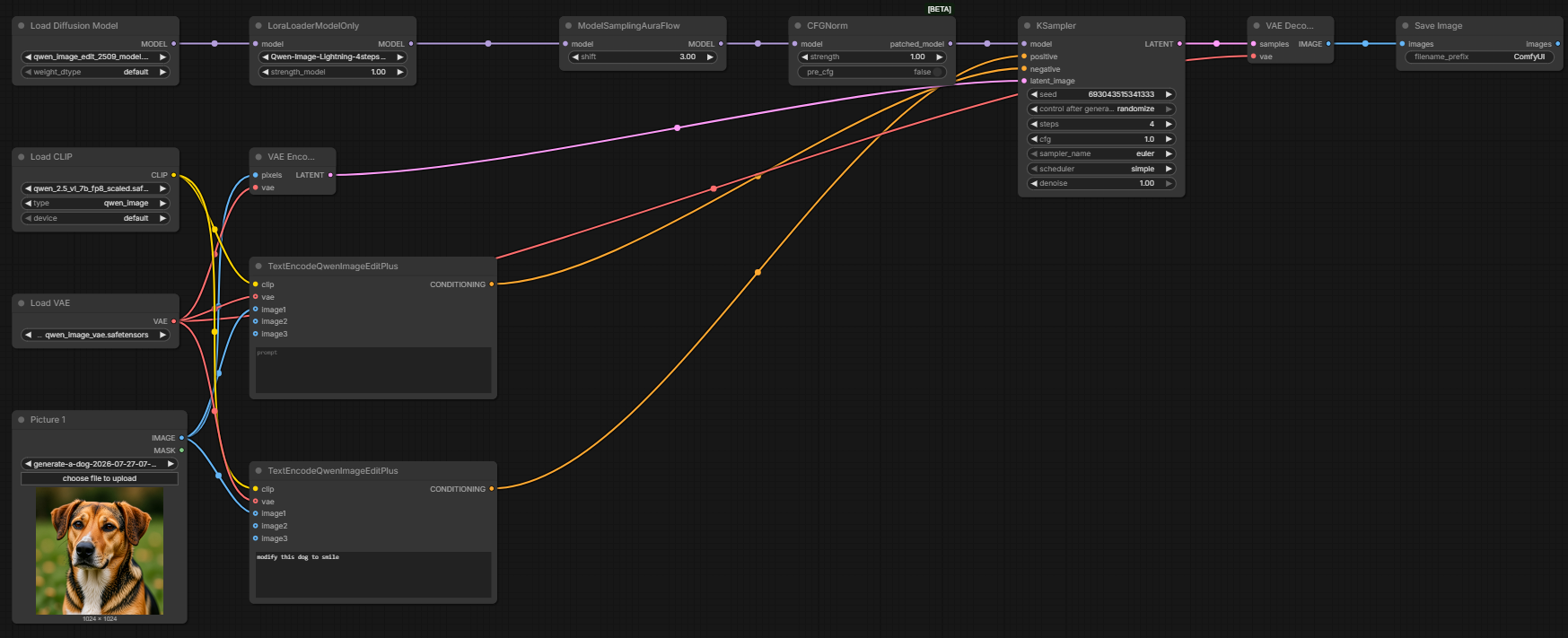
Installation steps
Step 1: Download qwen_image_edit_2509_fp8_e4m3fn.safetensors into/ComfyUI/models/diffusion_models/qwen_image_edit_2509_model.safetensors
Step 2: Download qwen_2.5_vl_7b_fp8_scaled.safetensors into /ComfyUI/models/text_encoders/qwen_2.5_vl_7b_fp8_scaled.safetensors
Step 3: Download qwen_image_vae.safetensors into /ComfyUI/models/vae/qwen_image_vae.safetensors
Step 4: Download Qwen-Image-Lightning-4steps-V1.0.safetensors into
/ComfyUI/models/loras/Qwen-Image-Lightning-4steps-V1.0.safetensors
Step 5: Download the qwen_2509_image_to_image-api.json workflow file into your home directory. Step 6: Restart ComfyUI so the newly added model files are detected. Step 7: Open the ComfyUI graphical user interface. Step 8: Load the
qwen_2509_image_to_image-api.json workflow file in the ComfyUI GUI.
Step 9: Load the source image you want to edit into the image input node.
Step 10: Enter a prompt that clearly describes the modification you want to make.
Step 11: Optionally adjust seed, steps, CFG, denoise strength, resolution, or sampler settings depending on how strongly you want the image to change.
Step 12: Run the workflow to generate and save the edited image.
Prerequisites
To run the workflow correctly, place the required Qwen 2509 model files, text encoder files, and VAE files into the proper ComfyUI model directories before loading the workflow. The exact filenames and folders should match the references used by the workflow JSON.
How to use this workflow in Videcool
Videcool can use this workflow to edit an existing image directly from a text instruction without requiring manual graph construction in ComfyUI. After importing the workflow, choose the source image, describe the intended modification, adjust the editing strength if needed, and execute the graph to produce a final edited image.
ComfyUI nodes used
- Load Image
- Load Diffusion Model
- LoraLoaderModelOnly
- ModelSamplingAuraFlow
- CFGNorm
- Load CLIP
- Load VAE
- TextEncodeQwenImageEditPlus (negative prompt)
- TextEncodeQwenImageEditPlus (positive prompt)
- VAE Encode
- KSampler
- VAE Decode
- Save Image
Base AI model
This workflow is built on Qwen 2509, a modern image editing model designed for prompt-guided image transformation. It is suitable for targeted edits, style changes, object adjustments, character refinements, and general creative iteration inside Videcool.
The workflow combines the Qwen 2509 model with the required prompt encoder and VAE components so that text instructions, latent editing, and final image reconstruction all work together in one practical local workflow. This makes it a useful starting point for creators who want controlled image edits as part of a local AI-assisted video production pipeline.
Image resolution
The output resolution depends on the workflow settings and the input image, and it can usually be adjusted directly in the relevant image preparation or latent sizing nodes. This makes it easy to keep the original size or prepare images for a different target resolution when needed.
Conclusion
The Qwen 2509 image edit ComfyUI workflow gives Videcool users a simple and effective way to modify images with natural language instructions. By combining source image input, prompt conditioning, latent editing, and final decoding in one clear graph, it provides a solid workflow for both quick edits and more advanced experimentation in local AI image production.