
Tango Flux Audio Generator ComfyUI workflow for Videcool
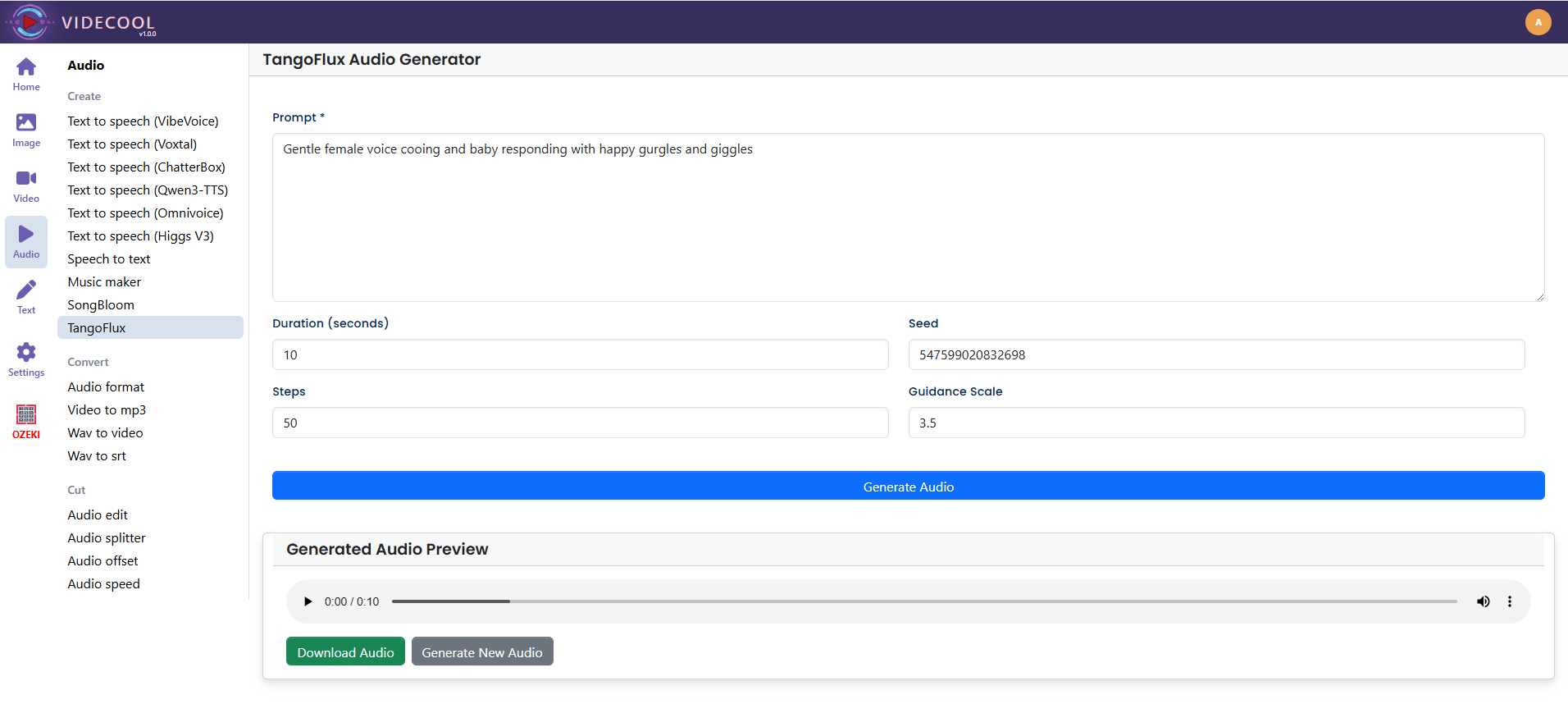
The Tango Flux audio generator workflow in Videcool provides a fast and flexible way to generate sound effects and audio from text prompts. Designed for speed, clarity, and creative control, this workflow is served by ComfyUI and uses the Tango Flux audio generation pipeline for high-quality text-to-audio synthesis.
What can this ComfyUI workflow do?
In short: Text-to-audio generation.
This workflow takes a text prompt and generates matching audio output, making it useful for sound effects, ambience, creative audio concepts, and experimental generation tasks. It interprets your prompt and produces an audio file that can be previewed and used in other Videcool projects. The workflow is optimized for efficient inference and uses TeaCache support to improve performance.
Example usage in Videcool
Download the ComfyUI workflow
Download ComfyUI Workflow file: tangoflux-api.json
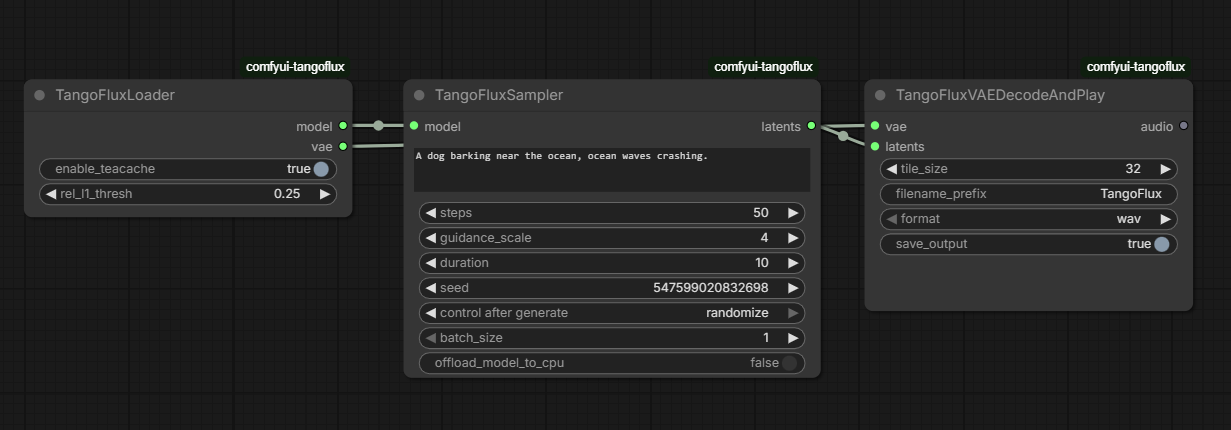
Image of the ComfyUI workflow
This figure provides a visual overview of the workflow layout inside ComfyUI. Each node is placed in logical order to establish a clean and efficient audio generation pipeline. The structure makes it easy to understand how the loader, sampler, and decode/playback nodes interact. Users can modify or expand parts of the workflow to create custom variations or integrate audio generation into larger media production pipelines.
Installation steps
Step 1: Install the Tango Flux ComfyUI custom node using ComfyUI Manager: Manage custom nodes → Search "TangoFlux" → Install.Step 2: Download or place the required Tango Flux model files into your ComfyUI model directory.
Step 3: Download the tangoflux-api.json workflow file into your home directory.
Step 4: Restart ComfyUI so the custom node and model files are recognized.
Step 5: Open the ComfyUI graphical user interface (ComfyUI GUI).
Step 6: Load the tangoflux-api.json workflow in the ComfyUI GUI.
Step 7: Enter the text prompt you want to convert into audio in the TangoFluxSampler node.
Step 8: Adjust generation settings such as steps, guidance scale, duration, and seed if needed.
Step 9: Hit run to generate the synthesized audio.
Step 10: Open Videcool in your browser and use the generated audio in your video projects.
Installation video
The workflow requires only a text prompt and a few basic parameter adjustments to begin generating audio. After loading the JSON file, users can set the prompt, adjust generation parameters such as duration and guidance scale, and run the workflow. Once executed, the audio generator produces an output file that can be used across other Videcool tools.
Prerequisites
To run the workflow correctly, install the Tango Flux custom node and make sure the required model files are available in your ComfyUI environment. These files ensure the model can interpret prompts, generate audio, and decode the output correctly. Proper installation into the following locations is essential before running the workflow: {your ComfyUI directory}/models/ and {your ComfyUI directory}/custom_nodes/.
ComfyUI models directory:
Place the Tango Flux model files in
your ComfyUI models path.
Custom Node: TangoFlux
Installed via ComfyUI Manager: Manage
custom nodes → Search "TangoFlux" → Install
How to use this workflow in Videcool
Videcool integrates seamlessly with ComfyUI, allowing users to generate audio directly without managing the underlying node graph. After importing the workflow file, simply enter a prompt, adjust generation settings if desired, and click generate. The system handles all backend interactions with ComfyUI. This makes audio generation intuitive and accessible, even for users who are not keen on learning how ComfyUI works. The following video shows how this model can be used in Videcool:
ComfyUI nodes used
This workflow uses the following nodes. Each node performs a specific role, such as loading the model, generating audio from text, and finally decoding and playing the output. Together they create a reliable and modular pipeline that can be easily extended or customized.
Base AI model
This workflow is built on Tango Flux, a modern text-to-audio generation pipeline designed for creating synthetic audio from natural language prompts. Tango Flux provides fast, flexible audio synthesis with a focus on expressive and practical output for creative workflows. More details, model weights, and documentation can be found in the ComfyUI node documentation or the associated model repository.
DeveloperTango Flux project maintainers
Audio quality and parameters
Audio quality depends on the prompt quality and generation settings. For best results, use clear prompts that describe the sound, ambience, motion, or scene you want to create. The workflow supports parameters such as steps, guidance scale, duration, seed, and batch size, allowing you to fine-tune the result. TeaCache is enabled by default in the loader node for improved efficiency.
Conclusion
The Tango Flux ComfyUI workflow is a practical, flexible, and user-friendly solution for generating audio in Videcool. With its modular ComfyUI pipeline and seamless platform integration, it enables beginners and professionals alike to produce creative audio content with ease. By understanding the workflow components and advantages, users can unlock the full potential of AI-assisted audio generation in Videcool.