
OmniVoice Text to Speech ComfyUI workflow for Videcool
The OmniVoice Text to Speech workflow in Videcool provides a powerful and flexible way to generate speech from text prompts. Designed for speed, clarity, and creative control, this workflow is served by ComfyUI and uses the OmniVoice long-form TTS pipeline together with a Whisper model component to synthesize spoken audio suitable for narration and longer passages.
What can this ComfyUI workflow do?
In short: Long-form text-to-speech synthesis.
This workflow takes text input and synthesizes speech audio without requiring a reference voice sample. It uses the OmniVoice long-form TTS node together with a Whisper loader dependency, and includes controls for steps, guidance scale, temporal shift, speed, duration, seed, chunk sizing, temperature values, denoising, and prompt preprocessing or postprocessing. The result is saved as an MP3 file, making the workflow suitable for narration, spoken scripts, and other long-form audio generation tasks in Videcool.
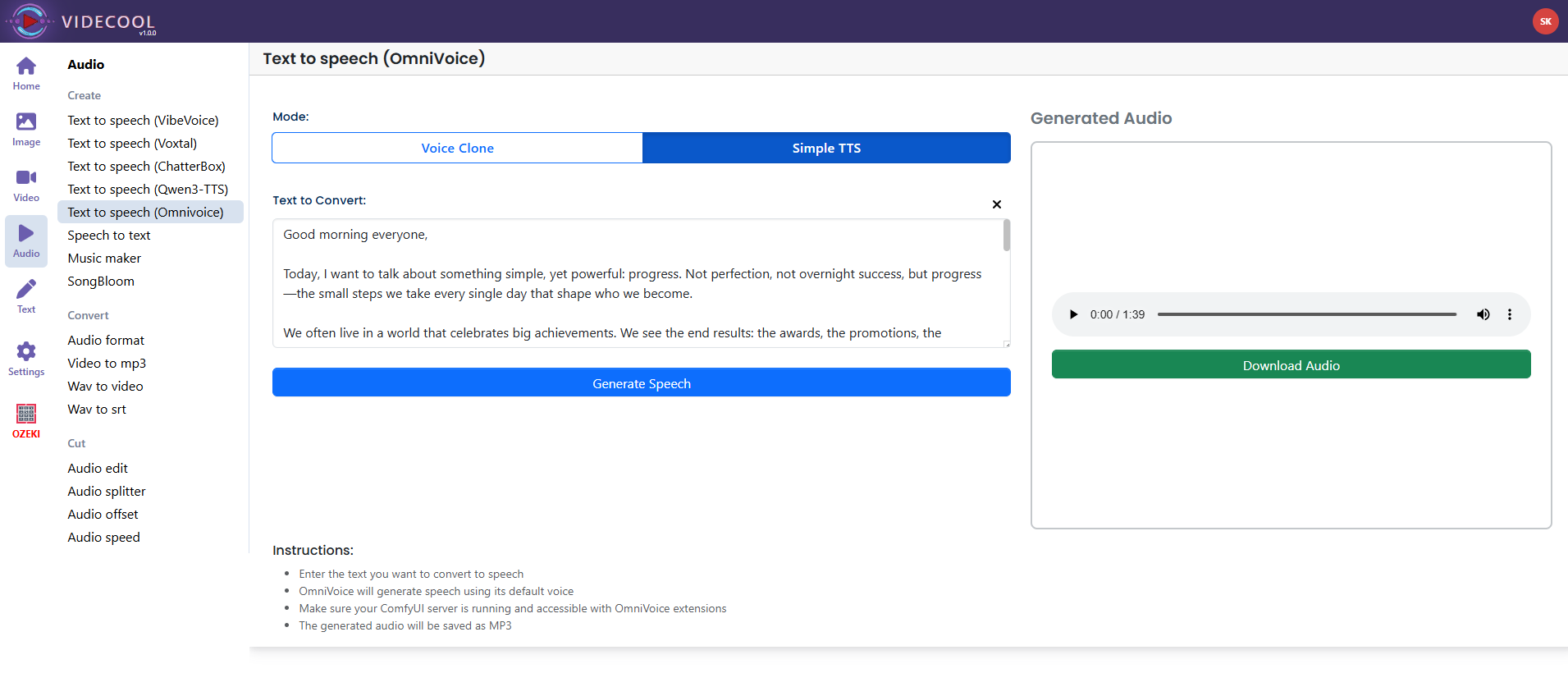
Example usage in Videcool
Download the ComfyUI workflow
Download ComfyUI Workflow file: ominvoice-text-to-speech-api.json
Image of the ComfyUI workflow
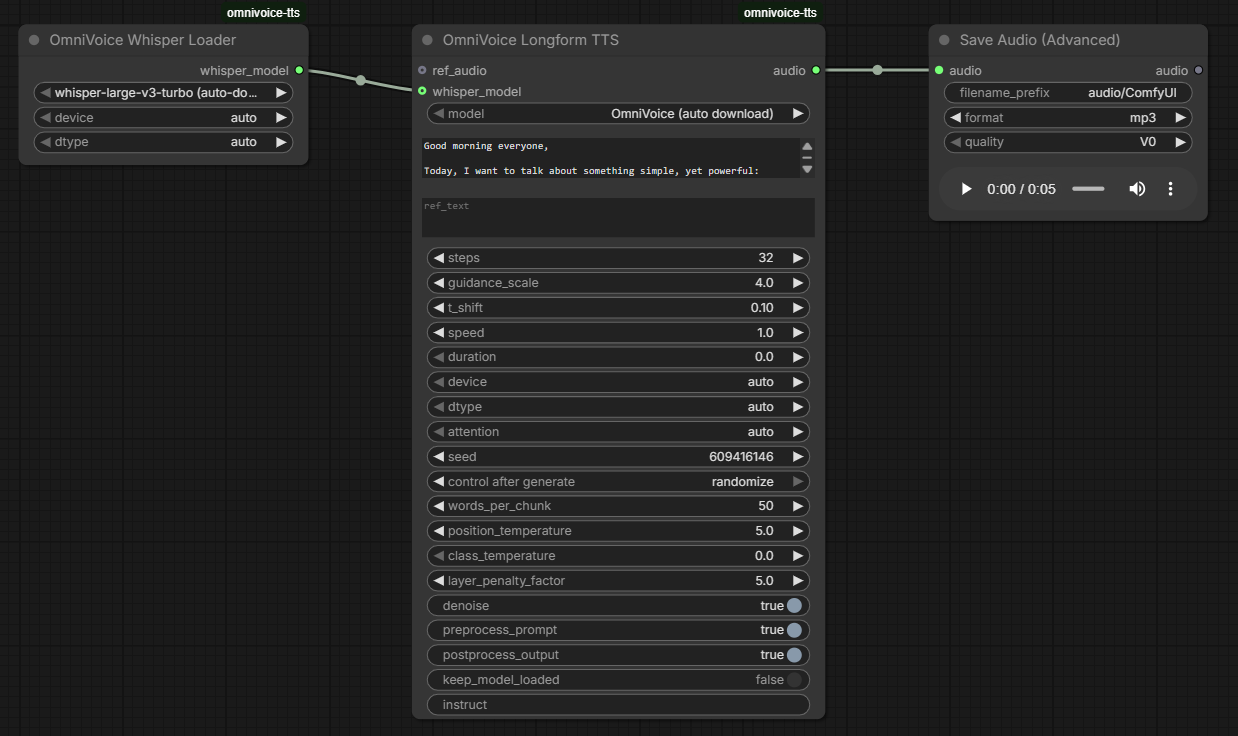
This figure provides a visual overview of the workflow layout inside ComfyUI. Each node is placed in logical order to establish a clean and efficient long-form text-to-speech pipeline. The structure makes it easy to understand how the OmniVoice Whisper loader, OmniVoice long-form generation node, and advanced audio save node interact. Users can modify the text prompt and generation parameters to create custom narration styles or integrate speech synthesis into larger audio or video production pipelines.
Installation steps
Step 1: Install the ComfyUI custom nodes or extension package that provides theOmniVoiceWhisperLoader, OmniVoiceLongformTTS, and
SaveAudioAdvanced nodes required by this workflow. Step 2: Ensure ComfyUI can access the Whisper model dependency specified in the workflow as
whisper-large-v3-turbo (auto-download), because the loader node is configured to
download or initialize that model automatically with device="auto" and
dtype="auto". Step 3: Ensure ComfyUI can access the OmniVoice model specified in the workflow as
OmniVoice (auto download), because the long-form TTS node is configured to load it
automatically with device="auto", dtype="auto", and
attention="auto". Step 4: Download the ominvoice-text-to-speech-api.json workflow file into your home directory.
Step 5: Restart ComfyUI so the custom node and model files are recognized.
Step 6: Open the ComfyUI graphical user interface (ComfyUI GUI).
Step 7: Load the
ominvoice-text-to-speech-api.json workflow in the ComfyUI GUI. Step 8: Enter the text you want to synthesize in the
OmniVoice Longform TTS
node. The attached workflow includes an example narration beginning with
Good morning everyone, Today, I want to talk about something simple, yet powerful: progress. Step 9: Optionally adjust the synthesis settings such as
steps,
guidance_scale, t_shift, speed, duration,
seed, words_per_chunk, position_temperature,
class_temperature, layer_penalty_factor, denoise,
preprocess_prompt, postprocess_output, and
keep_model_loaded. The attached workflow uses steps 32, guidance scale 4,
t_shift 0.1, speed 1, seed 42, words_per_chunk 50, position temperature 5, class temperature 0,
layer penalty factor 5, denoise enabled, prompt preprocessing enabled, output postprocessing enabled,
and keep_model_loaded disabled. Step 10: Run the workflow to synthesize speech and save the output through the
Save Audio (Advanced) node. The attached workflow saves audio as MP3 using the
filename prefix audio/ComfyUI and quality setting V0. Step 11: Open Videcool in your browser, select the Text to Speech tool, and use the generated audio in your video or narration projects.
Installation video
The workflow requires only text input and a set of generation parameters to begin producing speech. After loading the JSON file, users can enter narration text, tune long-form synthesis settings, and run the workflow to generate spoken audio. Once executed, the OmniVoice node produces speech output that is then saved as an MP3 file for reuse across other Videcool tools.
Prerequisites
To run the workflow correctly, install the ComfyUI custom nodes that provide the OmniVoice Whisper loader, OmniVoice long-form TTS, and advanced audio save nodes, then make sure the required model dependencies can be downloaded or accessed by ComfyUI. These components ensure the workflow can process text, initialize the Whisper and OmniVoice model dependencies, synthesize long-form speech, and save the result as an MP3 file. Proper installation into your ComfyUI custom node and model environment is essential before running the workflow.
Model dependencies used by the workflow
whisper-large-v3-turbo (auto-download)
OmniVoice (auto download)
Custom node classes required by the workflow
OmniVoiceWhisperLoader
OmniVoiceLongformTTS
SaveAudioAdvanced
How to use this workflow in Videcool
Videcool integrates seamlessly with ComfyUI, allowing users to generate speech directly without managing the underlying node graph. After importing the workflow file, simply enter your text, adjust the desired generation settings, and click generate. The system handles the backend interaction with ComfyUI, making long-form text-to-speech intuitive and accessible even for users who do not want to work directly with ComfyUI nodes.
ComfyUI nodes used
This workflow uses the following nodes. Each node performs a specific role, such as loading the Whisper dependency, running long-form text-to-speech generation, and saving the final output audio. Together they create a reliable and modular pipeline that can be easily extended or customized.
- OmniVoice Whisper Loader
- OmniVoice Longform TTS
- Save Audio (Advanced)
Base AI model
This workflow is built around the OmniVoice long-form TTS system together with a Whisper model
dependency configured as whisper-large-v3-turbo (auto-download). The attached workflow
uses the OmniVoiceLongformTTS node for speech generation and exposes a broad set of
controls for text chunking, guidance, temporal behavior, and output cleanup, making it suitable for
longer spoken passages and narration-oriented tasks.
Speech quality and parameters
Speech quality in this workflow depends on the entered text and the generation parameters. The attached workflow uses 32 steps, guidance scale 4, temporal shift 0.1, speed 1, seed 42, 50 words per chunk, position temperature 5, class temperature 0, layer penalty factor 5, denoising enabled, prompt preprocessing enabled, and output postprocessing enabled. These settings provide a practical starting configuration for long-form narration and general text-to-speech generation.
Conclusion
The OmniVoice Text to Speech ComfyUI workflow is a robust, practical, and user-friendly solution for generating speech in Videcool. With its combination of long-form speech generation controls, a modular ComfyUI pipeline, and seamless platform integration, it enables beginners and professionals alike to produce narration and spoken audio content efficiently for creative and production use.