
ChatterBox Text to Speech ComfyUI workflow for Videcool
The ChatterBox Text to Speech workflow in Videcool provides a powerful and flexible way to generate speech from text prompts. Designed for speed, clarity, and creative control, this workflow is served by ComfyUI and uses the ChatterBox TTS engine to synthesize spoken audio, with optional narrator voice input for voice-conditioned generation.
What can this ComfyUI workflow do?
In short: Text-to-speech synthesis with optional voice conditioning.
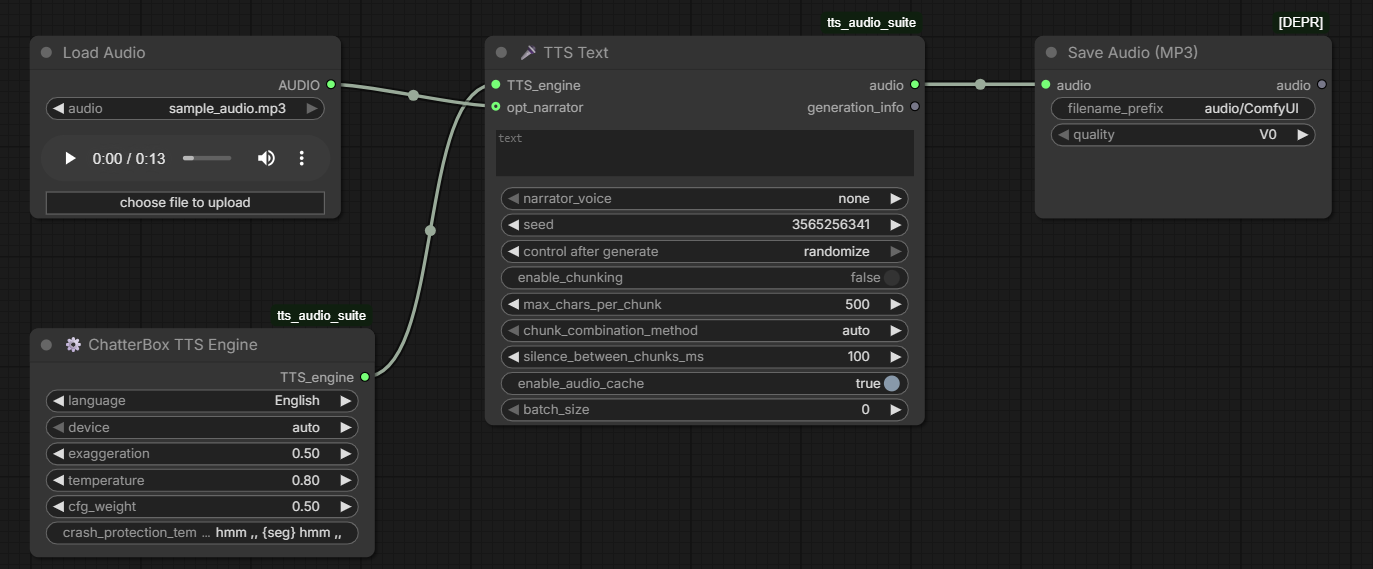
This workflow takes text input and can also use an optional reference audio file as a narrator voice source. It interprets your text prompt, applies the ChatterBox TTS engine settings, and outputs synthesized speech as an MP3 file. The workflow includes controls for language, device, exaggeration, temperature, CFG weight, seed, chunking behavior, silence between chunks, and audio caching, making it suitable for both short narration and longer generated speech tasks.
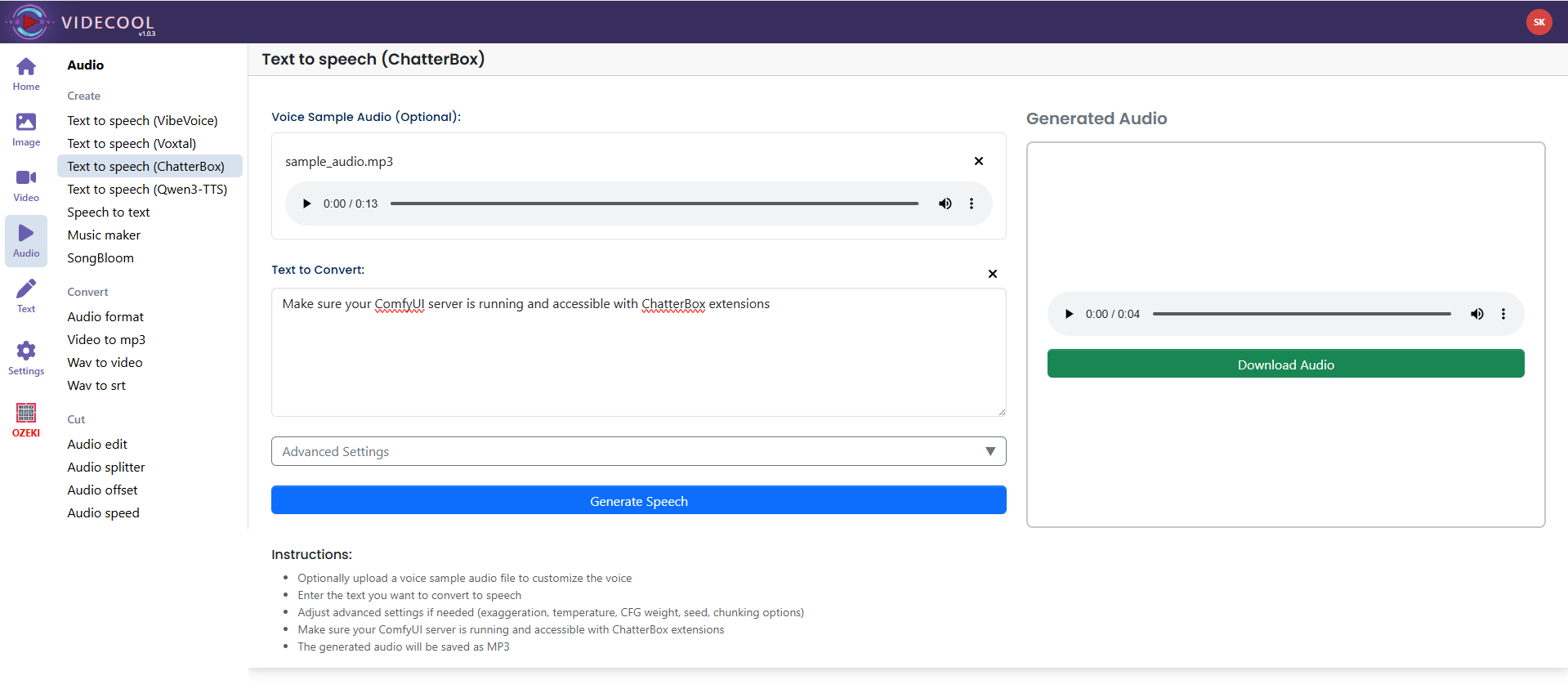
Example usage in Videcool
Download the ComfyUI workflow
Download ComfyUI Workflow file: chatterbox_text_to_speech-api.json
Image of the ComfyUI workflow
This figure provides a visual overview of the workflow layout inside ComfyUI. Each node is placed in logical order to establish a clean and efficient text-to-speech pipeline. The structure makes it easy to understand how the audio loader, ChatterBox TTS engine, text generation node, and MP3 audio output node interact. Users can modify or expand parts of the workflow to create custom narration styles or integrate generated speech into larger audio or video production pipelines.
Installation steps
Step 1: Install the ComfyUI custom nodes or extension package that provides theChatterBoxEngineNode and UnifiedTTSTextNode nodes required by this workflow. Step 2: Install or place the required ChatterBox model files according to the node package documentation so the TTS engine can initialize correctly. The attached workflow uses
language="English", device="auto", exaggeration=0.5,
temperature=0.8, and cfg_weight=0.5. Step 3: Download the chatterbox_text_to_speech-api.json workflow file into your home directory.
Step 4: Restart ComfyUI so the custom node and model files are recognized.
Step 5: Open the ComfyUI graphical user interface (ComfyUI GUI).
Step 6: Load the
chatterbox_text_to_speech-api.json workflow in the ComfyUI GUI. Step 7: In the
Load Audio node, optionally select a narrator or sample voice file.
The attached workflow uses sample_audio.mp3 as the example input audio. Step 8: Enter the text you want to synthesize in the
🎤 TTS Text node, then
optionally adjust settings such as seed, chunking, maximum characters per chunk, chunk combination
method, silence between chunks, audio cache, and batch size. The default workflow uses seed
3565256341, chunking disabled, max 500 characters per chunk, auto chunk combination,
100 ms silence between chunks, audio cache enabled, and batch size 0. Step 9: Run the workflow to generate speech and save the output as an MP3 file through the
Save Audio (MP3) node. The default filename prefix is audio/ComfyUI and
the MP3 quality is set to V0. Step 10: Open Videcool in your browser, select the Text to Speech tool, and use the generated audio in your video projects.
Installation video
The workflow requires text input and can also use a narrator audio sample, plus a few basic parameter adjustments to begin generating speech. After loading the JSON file, users can select the optional audio input, enter the text to be spoken, and tune synthesis settings such as exaggeration, temperature, CFG weight, chunking, and silence between chunks. Once executed, the workflow generates speech audio and saves it as an MP3 file that can be reused across other Videcool tools.
Prerequisites
To run the workflow correctly, install the ComfyUI custom nodes that provide the ChatterBox TTS engine and unified TTS text nodes, then install the required ChatterBox model files according to that package. These files ensure the workflow can process text, apply the selected TTS settings, optionally use narrator audio, and synthesize natural-sounding speech that is saved as an MP3 file. Proper installation into your ComfyUI custom node and model directories is essential before running the workflow.
Custom node classes required by the workflow
LoadAudio
ChatterBoxEngineNode
UnifiedTTSTextNode
SaveAudioMP3
How to use this workflow in Videcool
Videcool integrates seamlessly with ComfyUI, allowing users to generate speech directly without managing the underlying node graph. After importing the workflow file, simply enter your text, optionally provide a narrator voice sample, and click generate. The system handles the backend interaction with ComfyUI, making text-to-speech intuitive and accessible even for users who do not want to work directly with ComfyUI nodes.
ComfyUI nodes used
This workflow uses the following nodes. Each node performs a specific role, such as loading optional narrator audio, configuring the TTS engine, processing text input, synthesizing speech, and finally saving the output. Together they create a reliable and modular pipeline that can be easily extended or customized.
- Load Audio
- ⚙️ ChatterBox TTS Engine
- 🎤 TTS Text
- Save Audio (MP3)
Base AI model
This workflow is built around the ChatterBox TTS engine as exposed in ComfyUI through the
ChatterBoxEngineNode and UnifiedTTSTextNode nodes. The attached workflow is
configured for English output, automatic device selection, moderate exaggeration, and balanced
temperature and CFG settings, providing a practical starting point for natural-sounding narration
and generated speech tasks.
Speech quality and parameters
Speech quality depends on the entered text, the selected engine settings, and whether an optional narrator audio sample is supplied. The attached workflow uses English language mode, exaggeration 0.5, temperature 0.8, CFG weight 0.5, chunking disabled, a 500-character chunk limit, 100 ms silence between chunks, audio cache enabled, and a fixed seed for repeatability. These settings provide a sensible default starting point for narration, prompt-based speech generation, and longer text-to-speech tasks.
Conclusion
The ChatterBox Text to Speech ComfyUI workflow is a robust, practical, and user-friendly solution for generating speech in Videcool. With its combination of flexible TTS settings, optional voice conditioning, a modular ComfyUI pipeline, and seamless platform integration, it enables beginners and professionals alike to produce useful spoken audio content quickly and efficiently.